
Kitsap County Warrants and Official Sources
Kitsap County does not publish a standalone, searchable list of all active warrants online. That is not unusual. Most Washington counties handle warrants the same way. A warrant is a court order, and whether it appears in a public database depends on the court that issued it, the type of warrant, and whether the case record is sealed or otherwise restricted by law or court rule.
What Kitsap does offer is a set of linked official resources. The Kitsap County Prosecutor's Office homepage includes a direct link titled "Check to see if I have a warrant." That link is the county's own starting point for warrant self-checks. It is intended for individuals who believe a warrant may have been issued against them. The Prosecutor's office, led by Chad M. Enright, prosecutes felony charges referred by county and city law enforcement, and also handles misdemeanor and gross misdemeanor cases in partnership with Bainbridge Island, Poulsbo, and Port Orchard.
The Office of Public Defense provides a second official resource. Its public-facing page links a resource for people who need to "Quash a felony bench warrant." Public Defense represents people who cannot afford an attorney and who qualify as indigent under Washington law. If you have a felony bench warrant and meet the eligibility standard, Public Defense may be the right contact before you take any other action.
The Kitsap Web Jail Viewer is a third window into warrant data. When a person is booked into custody, each charge on their jail profile may show a "War.#" field, which is the warrant number tied to that specific charge. The field may be blank if no warrant was involved in the arrest. The jail viewer is not a warrant search tool in the traditional sense, but it does reveal warrant numbers for people who are already in custody.
Important: Do not rely on third-party warrant websites or data aggregators for Kitsap County. These sites pull data from incomplete sources, lag well behind actual court activity, and may show warrants that have already been resolved or miss warrants that were just issued. Use the Prosecutor, the courts, or the jail viewer only.
The Prosecutor's homepage is shown below. It is the official county starting point for warrant self-verification and for victim assistance, case status, and related criminal-justice links.
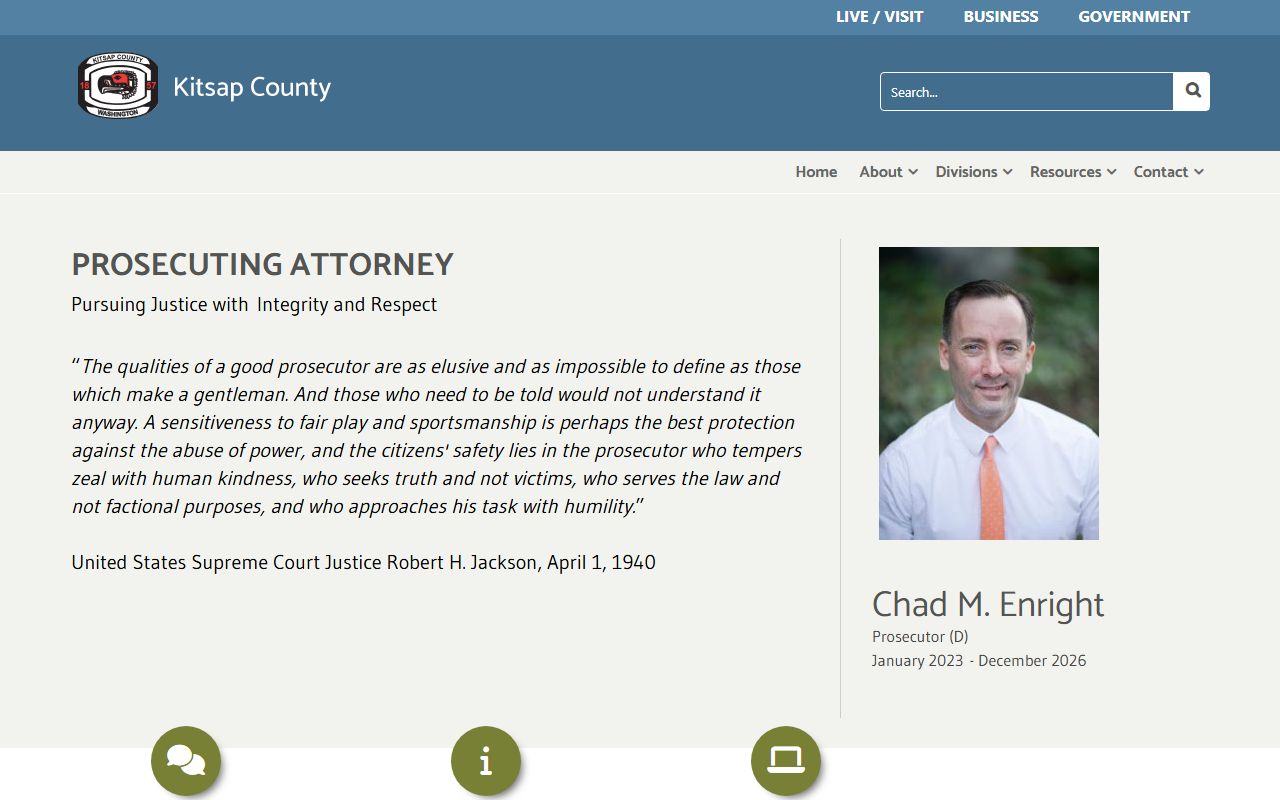
From the Prosecutor's homepage you can reach the warrant self-check link, the case-status page, and restitution and victim assistance contacts all in one place.
Types of Kitsap County Warrants
Washington courts issue several types of warrants, and each one works differently. Knowing the type matters because it shapes how the warrant is resolved, which court handles it, and what happens when law enforcement encounters the person named in it. The Kitsap jail records and official county sources reflect most of these types in the charge descriptions and case fields visible on booking profiles.
Arrest warrants and bench warrants are the types people encounter most often. A search warrant is a law enforcement tool that rarely appears in public booking records. Failure-to-appear warrants are common and visible in Kitsap jail records, where charge descriptions can read "FAILURE TO APPEAR / CONTEMPT OF COURT." Protection order violations can also trigger warrants and appear as charged violations on a jail booking profile.
- Arrest warrant - a court order that authorizes law enforcement to take a named person into custody based on probable cause that the person committed a crime.
- Bench warrant - issued directly by a judge, most often when a defendant fails to appear at a required court hearing or violates a court order. These are common in both Superior Court and District Court matters.
- Search warrant - authorizes law enforcement to search a specific location or seize specific items. Search warrants are usually sealed before and during execution and may stay restricted from public view depending on the case.
- Failure-to-appear warrant - a bench warrant specifically tied to a missed court date. In Kitsap jail records, this shows up as a charge description in the violation field on an inmate profile.
- Protection order violation warrant - issued when a person violates a no-contact order or a protection order. These appear as charged violations on Kitsap booking records and can be visible through the Web Jail Viewer when the person is in custody.
Note: Juvenile warrants and sealed warrants are generally not available to the public. Court rules and Washington law restrict access to juvenile records under chapter 13.50 RCW, and sealed warrant records require a court order to view.
Warrant Fields in the Kitsap Jail Viewer
The Kitsap County Web Jail Viewer shows public inmate profiles for people currently booked into the Kitsap County Sheriff's Office Jail. Each profile breaks charges into individual rows. A warrant number field, labeled "War.#", may appear on each charge row. This is not a search tool for outstanding warrants, but it does expose warrant numbers for people already in custody, and it gives a real look at what warrant-related data appears in official Kitsap jail records.
The table below lists the per-charge fields that appear on a Kitsap jail booking profile, drawn directly from the Web Jail Viewer. The warrant and court fields sit alongside charge and bond data so a reader can see the full picture of a charge as the jail system records it.
| Field | What It Shows |
|---|---|
| War.# | Warrant number tied to this specific charge. May be blank if no warrant was part of the arrest. |
| Court Type | The court that has jurisdiction over the charge. "SC" indicates Superior Court. |
| Court Case # | The linked court case number text for the charge, if one exists. |
| Next Court Date | The scheduled court date for this charge, if one is set. |
| Req. Bond/Bail | Bond or bail type code. Examples observed in the jail system include C/B, RF, and GL. |
| Req. Bond Amt / Req. Cash Amt | The dollar amount of bond or cash bail required per charge. |
| Clearance | Status code per charge. Examples include RF and TS. The field may also be blank. |
| Violation / Level | The RCW statute code and short charge description, along with the charge level. Examples include FC for Class C felony and FB for Class B felony. |
Keep in mind that the War.# field may be blank for many charges. Blanks do not mean no warrant exists; they may reflect how the arresting agency entered the booking data. Contact the jail at 360-337-7108 directly if you need to confirm warrant status for a specific booking.
The image below shows the Kitsap County Sheriff's Office web page, which links the Web Jail Viewer and other inmate-related resources.
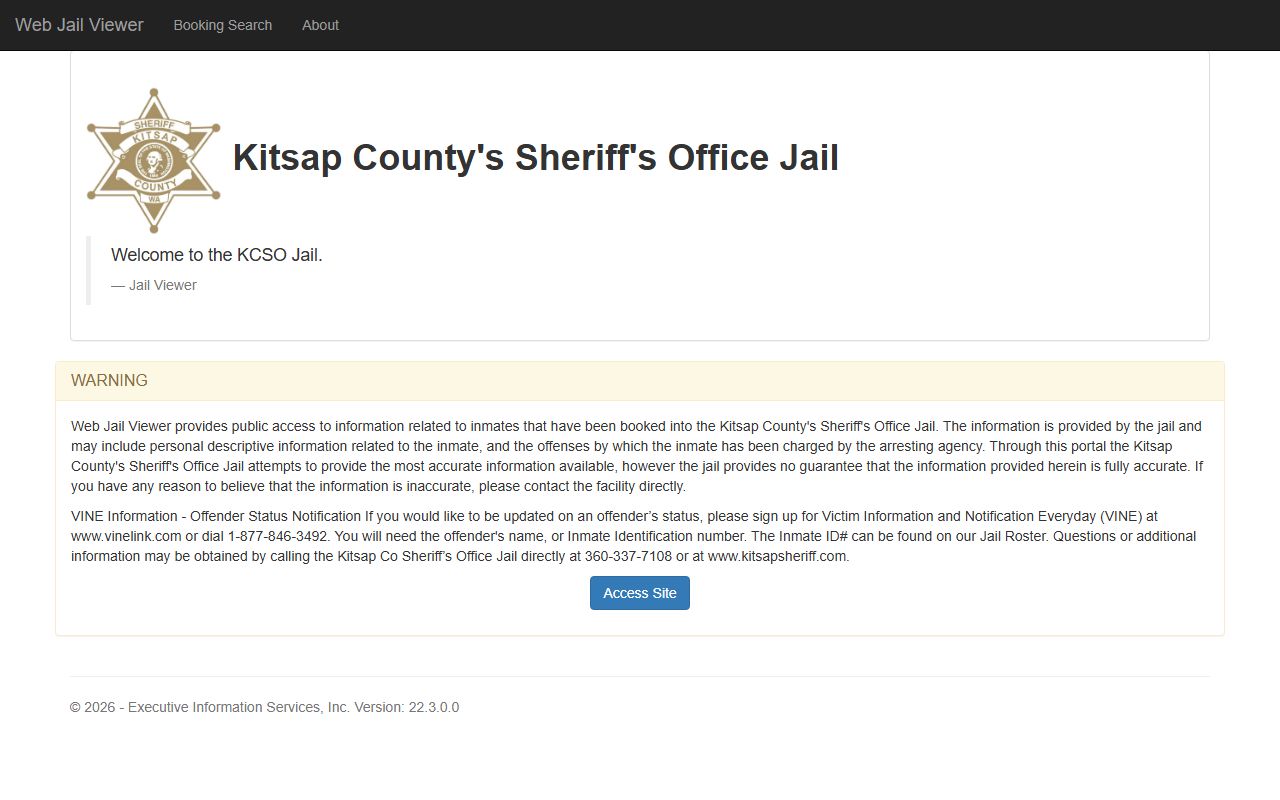
The Sheriff's page also links visitation and mail information for families of people in custody, as well as VINE registration for custody notification.
How to Use the Kitsap Web Jail Viewer
The Web Jail Viewer at incustody.kitsap.gov is the county's public booking-search tool. It shows people currently held and recently released from the Kitsap County Sheriff's Office Jail. The viewer is a public resource, but it requires users to read and accept a warning before accessing the search. That warning notes that the information comes from the jail, may not be fully accurate, and should be confirmed with the facility for anything critical.
The search accepts any single field or a combination. You do not need all fields to run a search. If exact spelling is uncertain, a percent sign (%) works as a wildcard anywhere in a name, so "sm%th" returns Smith, Smyth, and similar entries. Results show the booking number, name, race, sex, booking date, release date, and scheduled release date. Click a row to reach the full profile, which is where the charge-level fields including War.# appear.
The image below shows the Web Jail Viewer booking search results page, which includes the per-charge rows where warrant fields appear.
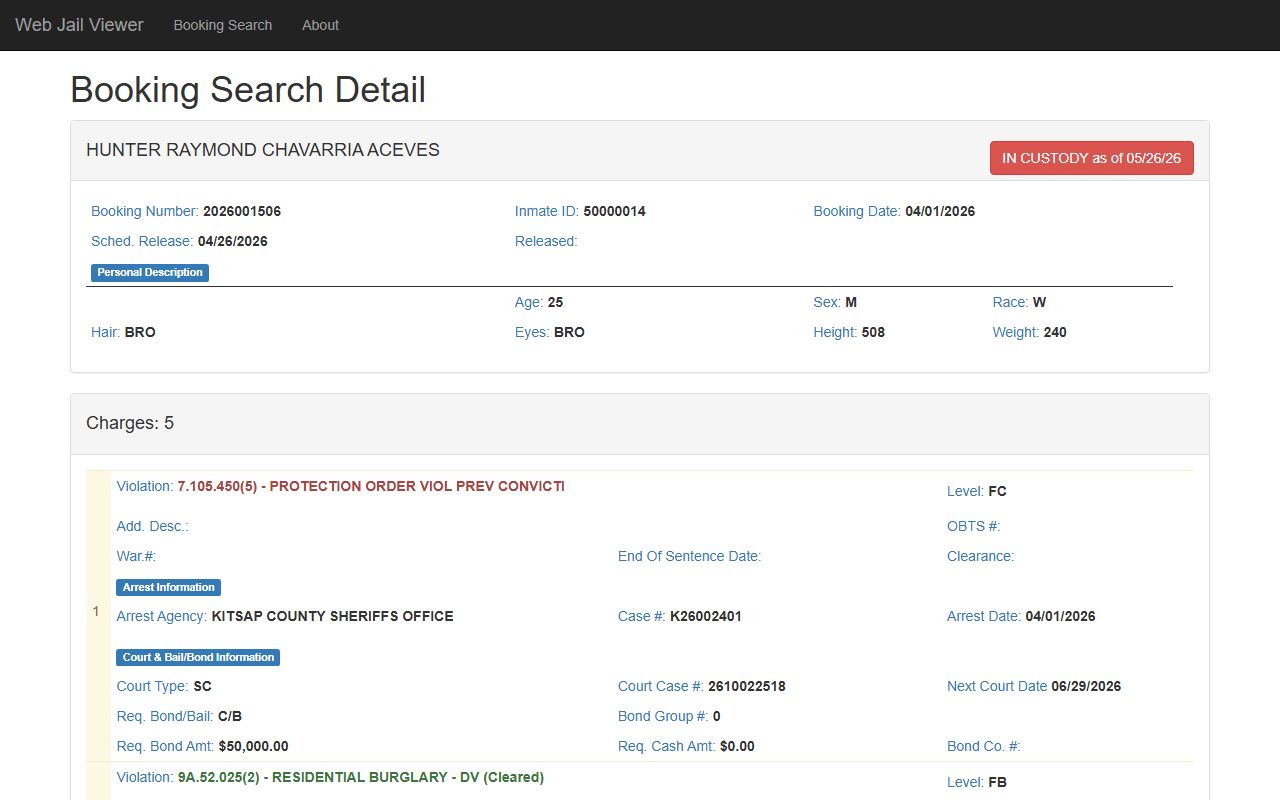
The results list includes sorting links on each column header, which lets you sort by booking date to find recent bookings quickly.
For a full walkthrough of the jail roster fields, booking process, and what each field on an inmate profile means, see Kitsap County inmate records.
Checking Kitsap County Court Records for Warrants
Court case records sometimes show whether a warrant was issued as part of a case. The Washington Courts statewide case search at dw.courts.wa.gov gives basic case status and court-date information across the state. It is a reasonable first stop when you need to check the status of a specific case. The statewide tool does not provide a dedicated warrant-status field, but if a hearing date is missing or a bench warrant was issued, the case status may reflect that.
For District Court cases, the District Court ePortal allows public users with a free account to search case records by name or case number. District Court handles misdemeanors, gross misdemeanors, traffic infractions, and some protection order matters, so bench warrants tied to those case types may be traceable through the ePortal if the case record is accessible. The ePortal's search guide covers calendar search by name, attorney, officer, and courtroom.
For Superior Court cases, the Washington State Digital Archives and the Washington Odyssey Portal are the main public paths for document-level search. Superior Court handles felonies, and felony bench warrants are the type the Public Defense page specifically addresses. See Kitsap County court records for the full search workflow across both courts.
Note: A warrant issued by a court does not always appear in public case records before it is served; contact the issuing court or your attorney for confirmation.
How to Resolve an Outstanding Kitsap County Warrant
An outstanding warrant does not go away on its own. It stays active until a court recalls it or a person is arrested on it. The right path depends on the warrant type, the issuing court, and whether the person has an attorney. Ignoring a warrant makes things worse. Courts can add a no-bail hold, issue new failure-to-appear charges, and flag the warrant in state law enforcement systems, which means any traffic stop or other police contact can result in immediate arrest.
The steps below reflect the guidance available through Kitsap's official channels. An attorney can advise on the best sequence based on the specific court and charge. Acting before a police encounter is almost always better than waiting.
- Confirm the warrant exists. Use the Prosecutor's warrant self-check link at the Prosecutor's homepage, check the court case record through the statewide court search or District Court ePortal, or call the issuing court directly. Do not rely on unofficial databases or data aggregators for confirmation.
- Identify the issuing court. Misdemeanor and gross misdemeanor bench warrants typically come from Kitsap County District Court or a city municipal court. Felony bench warrants come from Kitsap County Superior Court. The court named on your original paperwork tells you where the warrant lives.
- Contact an attorney before taking any other step. If you cannot afford one and the charge is criminal, contact the Kitsap County Office of Public Defense at 360-337-7015 to ask whether you qualify for representation. Public Defense is at 614 Division Street, Room 103, Port Orchard, WA 98366, and is open Monday through Friday, 8:00 a.m. to 4:30 p.m., closed noon to 1:00 p.m.
- For a felony bench warrant, Public Defense publishes a specific resource for quashing the warrant. Ask about filing a motion to quash, what a quash hearing involves, and whether the judge requires you to appear or surrender first.
- For a District Court bench warrant tied to a missed hearing, contact District Court at 360-337-7109 or go to Room 106 at 614 Division Street to ask about the recall process. Some bench warrants can be addressed by scheduling a new hearing.
- Ask about bond. Many warrants carry a bond or bail amount that appears in the court record or jail profile. Knowing the amount before you appear or surrender can help you plan. The Req. Bond Amt and Req. Cash Amt fields on the jail profile reflect what the court set when it issued the warrant.
- Do not miss any new court date. Once a warrant is addressed and a hearing is set, missing that new date creates another warrant and may remove any existing release conditions.
The Prosecutor's office notes that it cannot provide legal advice to the public because of Washington law and professional conduct rules. If you need legal guidance, the official referral is to an attorney or, for those who qualify, to Public Defense.
Bond and Bail on Kitsap County Warrants
When a judge issues a warrant, the order often sets a bond or bail amount. Bond is the security required before a person is released from custody. Bail is the cash amount or surety arrangement that substitutes for full detention pending a court date. The Kitsap jail profile displays several bond-related fields per charge, and these reflect what the court entered when the warrant or hold was established.
- Req. Bond/Bail
- A code that indicates the bond type the court ordered. Common examples seen in Kitsap jail records include C/B (cash or bail bond) and RF and GL, which reflect specific bond conditions or requirements.
- Req. Bond Amt
- The total bond amount set per charge. This is the face value of the bond the court requires.
- Req. Cash Amt
- The cash portion required. Courts sometimes allow a percentage of the bond to be posted in cash as a deposit; this field shows the required cash figure.
- Bond Group #
- An administrative reference that groups related charges or bail conditions when multiple charges share a single bond arrangement.
- Bond Co. #
- A bondsman or surety company reference number, which may be blank if no bond company is involved.
Bond amounts on warrants are set by the issuing court, not by the jail. They can be modified by a judge at a first appearance or bail review hearing. If you believe the bond amount is excessive or that no bail hold is justified, an attorney can file a motion for bail reduction in the issuing court.
Prosecutor and Public Defense Resources
Two county offices handle the legal side of warrant resolution. They serve different roles, and reaching the right one first saves time. The Prosecutor represents the state in criminal cases. Public Defense represents defendants who qualify as indigent. Neither can give legal advice to the general public outside their official role, but both publish self-help links that are directly useful for people dealing with warrants.
The Kitsap County Prosecuting Attorney's Office is led by Chad M. Enright, who has served since January 2023. Divisions include Felony, Civil, District/Municipal, and Family Support. The Prosecutor's page links warrant self-check, case status, restitution, victim assistance, firearm rights restoration, and therapeutic courts. The office is at 614 Division Street in Port Orchard and is open from 8:30 a.m. to noon and 1:30 p.m. to 4:30 p.m., Monday through Friday.
The Office of Public Defense is at 614 Division Street, Room 103, Port Orchard, WA 98366. The main phone is 360-337-7015. Public Defense provides client-focused representation for people charged with crimes who cannot afford an attorney and who meet the indigency standard under Washington law. Cases not handled by staff attorneys are assigned to qualified local lawyers with experience in felonies, misdemeanors, juvenile matters, dependencies, and civil contempt. The Public Defense page links court dates, the jail roster, the Washington DOC locator, attorney resources, local court rules, and the statewide public defense offices network.
For underlying criminal records tied to a warrant, Superior Court case files are accessed through the Clerk or the Digital Archives, and District Court files are available through the ePortal. See Kitsap County court records for the full access workflow.
Restricted Warrant Records in Kitsap County
Not all warrants in Kitsap County are accessible to the public. Several categories are restricted by law or by court order, and the restriction is not always obvious from the outside.
Juvenile warrants fall under chapter 13.50 RCW, which governs the keeping and release of juvenile court records. The county cannot confirm or deny whether a juvenile record exists unless the law allows it. This means warrant records tied to juvenile cases are treated as confidential, and public sources will not reflect them.
Search warrants are typically sealed before they are executed. After execution, some search warrants remain sealed by court order if the disclosure would endanger an investigation, a witness, or a pending prosecution. A member of the public generally cannot access a sealed search warrant through the Clerk or any portal without a court order.
Sealed warrants connected to sealed cases follow the same path. If a case record has been sealed under court rule GR 15, the warrant that is part of that record is also not publicly accessible. To request access to a sealed record, a person must petition the court that handled the case and show a legal basis for access. Federal warrants issued by the U.S. District Court for the Western District of Washington are not accessible through Kitsap county systems and follow federal court rules.
For people who believe a record was sealed in error or who want to understand whether a vacation order cleared a related warrant, the Kitsap Public Defense page links help for quashing and sealing records and Blake refund and dismissal materials. Washington Courts provides forms and interviews for vacating convictions. Felony vacation runs under RCW 9.94A.640; misdemeanor vacation under RCW 9.96.060.
Why Third-Party Warrant Sites Fall Short
A number of commercial websites claim to offer warrant searches. They aggregate data from court systems, booking records, and public safety reports, then resell access to the results. The problem is that their data is almost never current. A warrant that was recalled last week may still appear as active on a third-party site. A warrant issued this morning will not appear there at all. Acting on bad data from one of these sites can lead to a missed court date, an unnecessary bond payment, or worse, a false sense that no warrant exists when one actually does.
Kitsap's official resources are specific and current. The Prosecutor's self-check, the court portals, the jail viewer, and direct contact with the court or jail reflect actual system data. None of these official sources charge a fee for basic warrant verification. Third-party sites almost always do, and that fee buys you information that may not match what the Kitsap courts and jail actually show.
Use the Prosecutor's homepage, the Web Jail Viewer, and the court portals. If you have questions about a specific case, call the court or the jail directly. For broader questions about criminal charges and court history, see Kitsap County arrest records or the Kitsap County court records FAQ.