
Washington's Public Records Act in Kitsap County
Washington's open-records law is found in chapter 42.56 RCW. The act starts with a clear statement in RCW 42.56.001 that disclosure is the default posture and that the people have a right to access public information. Every exemption is supposed to be read narrowly. The purpose is government accountability, not agency convenience. Kitsap County implements the act through its Department of Administrative Services, which runs the Public Records Center at kitsap.gov/das/Pages/public-records.aspx.
RCW 42.56.010 sets out the definitions. A "public record" is a writing containing information relating to the conduct of government or the performance of any governmental or proprietary function prepared, owned, used, or retained by any state or local agency. "Agency" includes local agencies such as county departments. Private communications, attorney-client materials, and some personnel files fall outside the definition of public records, but most county business records do not.
The act requires agencies to make nonexempt public records available for inspection and copying under RCW 42.56.070. Copying charges are addressed in RCW 42.56.120. Agencies must publish their fee schedules so requestors know what to expect. RCW 42.56.030 reinforces that the law should be liberally construed to favor disclosure. That means if a county official is unsure whether something qualifies as exempt, the default is to disclose.
The Kitsap County public records page captures this clearly. The county says requests go through the Public Records Center, which lets requestors make requests, review and download responsive records, and communicate with county staff. Sheriff's records are requested directly to the Sheriff's Office through a separate option in the same portal.
Key Statutes for Kitsap County Public Records:
RCW 42.56.001: Policy and purpose; open records as a fundamental right.
RCW 42.56.010: Definitions of public record, agency, and person in interest.
RCW 42.56.030: Liberal construction of the act; narrow reading of exemptions.
RCW 42.56.070: Requirement to make records available; fee publication.
RCW 42.56.080: Identifiable records; inspection and copying rights.
RCW 42.56.120: Copy charges and fee schedule requirements.
RCW 42.56.240: Law enforcement and investigative record exemptions, including certain sheriff and warrant records.
Public Records vs. Kitsap County Court Records
People often send a public records request to Kitsap County expecting to get court case files back. That usually does not work. Kitsap County draws a clear line between agency public records and court records. The county's public records page cites WAC 44-14-01001 and explains that access to court records is governed by court rules and common law, not the Public Records Act. Most court files are open and accessible, but the path runs through the clerk's office or the court portals, not the Public Records Center.
Court administrative records are a third category. Things like court budget documents, HR files, and operational records that the court itself holds as a government body fall under General Rule 31.1. GR 31.1 requests for Kitsap Superior Court administrative records go to the Superior Court directly at kitsap.gov/sc/Pages/GR31-1-Request.aspx. District Court has its own GR 31.1 form at kitsap.gov/dc/Pages/Forms.aspx. These are not the same as asking for a copy of a case file.
The table below shows where to go depending on the type of record you need.
| Record Type | Where to Request | Governing Law |
|---|---|---|
| County agency records (permits, contracts, budgets, county emails) | Kitsap County Public Records Center (GovQA) | Chapter 42.56 RCW (PRA) |
| Sheriff records (incident reports, arrest records) | Sheriff's Office option inside the Public Records Center | Chapter 42.56 RCW; RCW 42.56.240 exemptions |
| Superior Court case files (felonies, divorce, probate) | Clerk of the Superior Court; Digital Archives; Odyssey Portal | GR 31; court rules and common law |
| District Court case files (misdemeanors, traffic) | District Court ePortal | GR 31; court rules |
| Court administrative records | Superior Court or District Court GR 31.1 request form | GR 31.1 |
| Auditor records (marriage licenses, deeds, recorded documents) | Kitsap County Auditor | Chapter 42.56 RCW; RCW 65.04 |
Note: Sending a Public Records Act request to the Public Records Center for court case documents will not get you those files. The clerk and court portals handle case copies directly under their own fee schedules.
The Kitsap County Public Records Center (GovQA)
Kitsap runs its public records request system through GovQA, a request-management platform the county uses to track, process, and deliver records. The portal address is kitsapcountywa.govqa.us. From there you can create a new request, check on a pending one, and download records the county has released. The portal keeps a record of every request you submit, which is useful if a dispute arises about what you asked for or when.
The screenshot below shows the Kitsap County Public Records Center portal homepage. It is the starting point for all county agency public records requests except those covered by a dedicated departmental process.
The Kitsap County Public Records Center is the official GovQA portal for submitting open-records requests online to county departments.
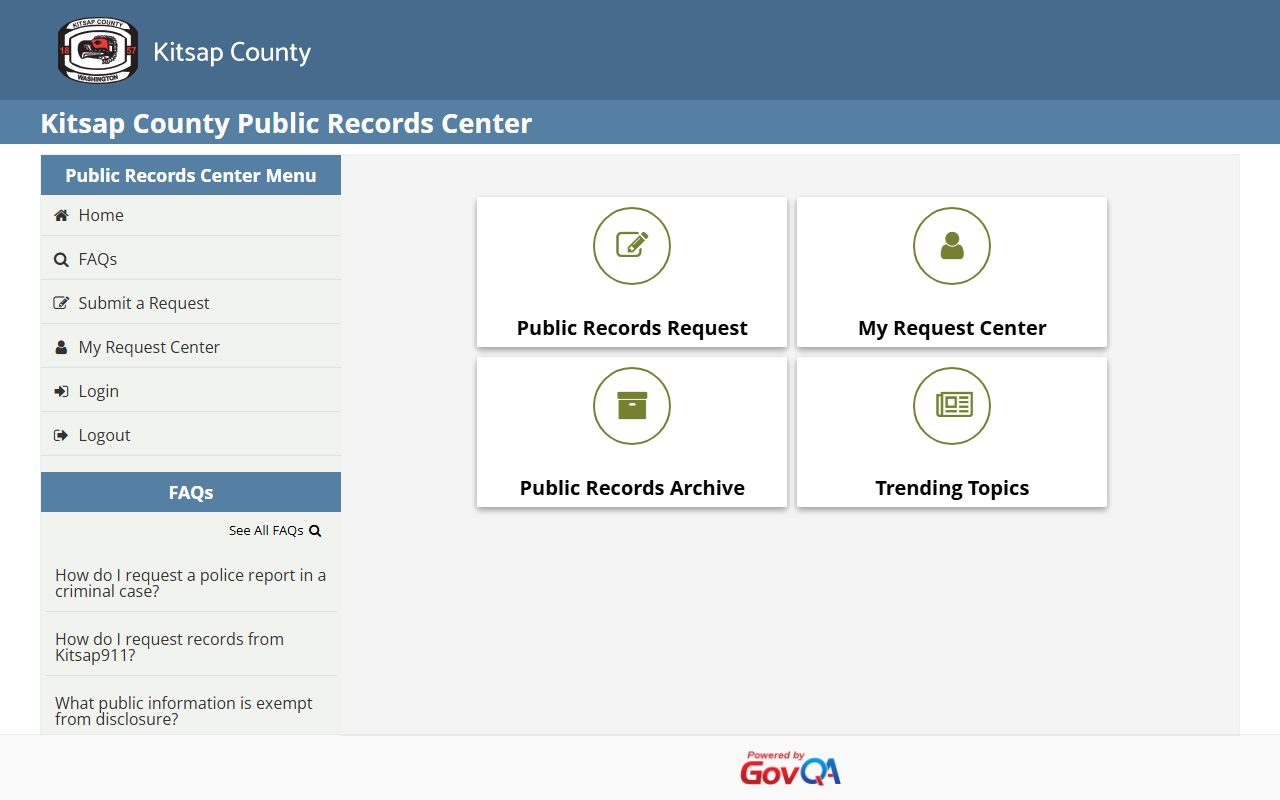
The portal gives you a case number when your request is received. Keep that number; you will need it to check status and communicate with county staff if questions come up.
How to File a Kitsap County Public Records Request
Submitting a public records request is not complicated. The main things are knowing which office holds the records, describing the records clearly, and choosing how to submit. The county offers the online portal as the easiest route. Mail and in-person options exist for people who prefer them. The steps below follow the standard county process.
- Identify the right office. County agency records go through the Public Records Center at kitsap.gov/das/Pages/public-records.aspx. Sheriff records go through the Sheriff option inside that same portal. Court case files go to the Clerk of the Superior Court or the District Court ePortal. Do not use the PRA portal for court case documents.
- Describe the records you want. Under RCW 42.56.080, requests must be for identifiable records. Be as specific as you can. Include a date range, names involved, subject matter, and the department or office most likely to hold the file. Vague requests slow things down and may result in a clarification call before processing begins.
- Submit your request. Use the GovQA portal online at kitsapcountywa.govqa.us, or mail a written request to the appropriate county department. Online submission is the fastest route and creates an automatic confirmation.
- Wait for the initial response. Washington law requires the county to respond within five business days of receipt. That response will either provide the records, deny the request with reasons, or acknowledge the request and give a reasonable time estimate for production. Five business days is the initial-response deadline, not the deadline to produce every document.
- Pay any fees and receive the records. The county will notify you of any copying fees before sending records. Pay through the portal or by the method the county specifies. Records are usually delivered through the GovQA portal as downloadable files.
You do not need a lawyer to submit a public records request. You do not need to explain why you want the records. Washington law does not allow the county to condition a request on your purpose. You may use any name, including your own, and submit as an individual or organization.
Public Records Request Form Fields
When you submit through the GovQA portal, the system walks you through a form. The table below covers what you will see and why each field matters. Filling in as much as you can helps the county find records faster and reduces back-and-forth.
| Field | Required | Notes |
|---|---|---|
| Requester Name | Yes | Any name is accepted. Washington does not restrict requestors by residency or identity. |
| Contact Email or Phone | Yes | The county needs a way to reach you for clarification or to deliver records. |
| Department or Agency | Recommended | Choosing the right department (e.g., Sheriff, Auditor, DAS, Public Works) routes the request faster. |
| Description of Records | Yes | Be specific. Include document type, subject, parties, and context. Vague descriptions may trigger a clarification step. |
| Date Range | No | A date or date range narrows the search and speeds production. If unknown, say "approximate" or leave open-ended. |
| Format Preference | No | Most records are delivered electronically. Hard copy by mail is available for a fee. Electronic is faster and cheaper. |
| Fee Limit | No | You can state a maximum dollar amount you are willing to pay. The county must notify you before charges exceed that limit. |
The county's public records page is the reference point for the current portal form. The DAS page at kitsap.gov/das/Pages/public-records.aspx shows the current instructions and a direct link to the GovQA portal.
The screenshot below shows the county public records DAS page, which explains the five-business-day rule, the portal link, and the Sheriff records option.
The Kitsap County DAS public records page is the official gateway with portal instructions, fee information, and the five-business-day response policy.
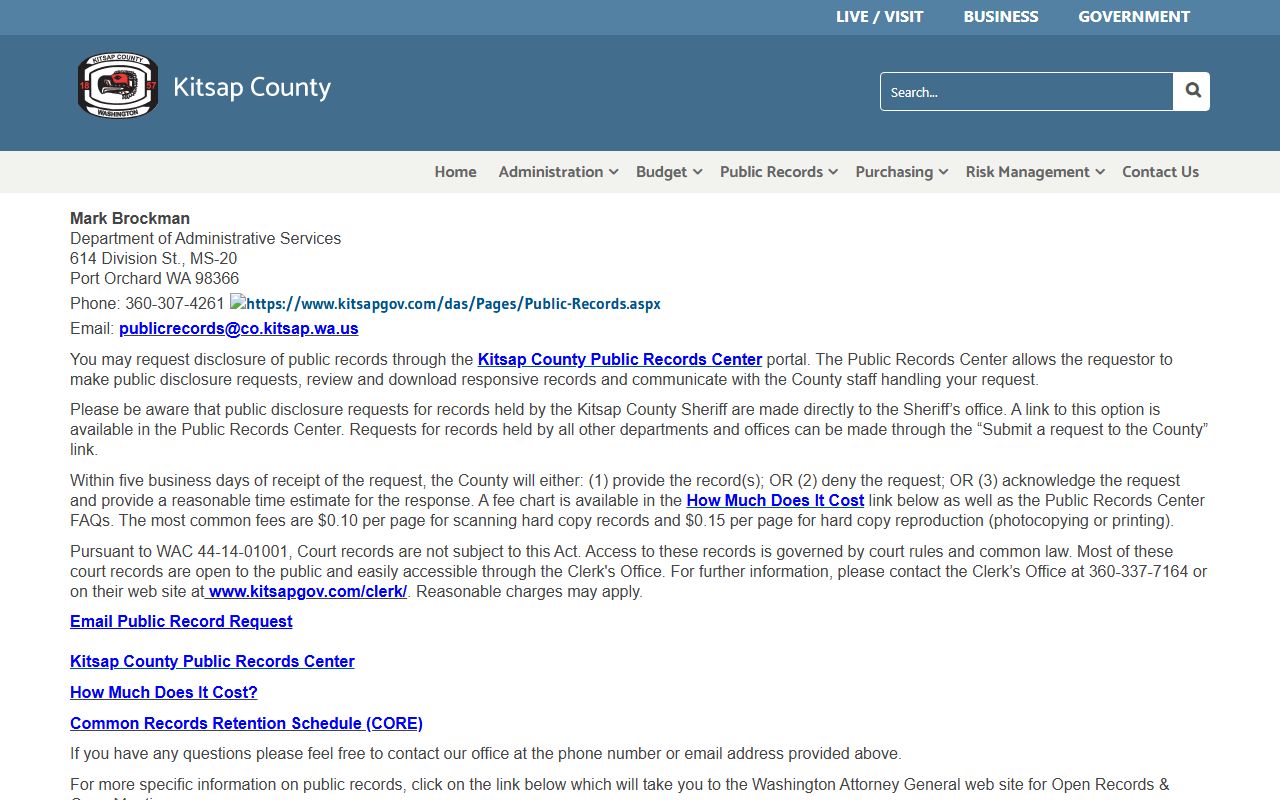
The page also notes that the Sheriff's Office handles its own records requests through a separate option inside the portal rather than through the main DAS queue.
Response Timelines and the Five-Business-Day Rule
One of the most misunderstood parts of the Public Records Act is what "five business days" actually means. People often expect to receive all their records within five days. That is not what the law requires. What Washington law requires is that within five business days of receiving your request, the county must take one of three actions: provide the records, deny the request with a written explanation and citation to an exemption, or acknowledge the request and give you a reasonable time estimate for when the records will be produced.
The production deadline is the "reasonable time estimate" the county gives in that initial response. That estimate depends on how many records match your request, how complex the search is, whether records require review for exempt material, and the county's current workload. A request for a single recent document might be filled quickly. A request spanning years of records from multiple departments could take much longer, and the county may produce records in installments.
If the county denies your request, the denial letter must cite the specific statutory exemption that applies. A general "we decline to release" response is not enough. If you believe a denial is wrong, you have options.
Important: The five-business-day clock is an initial-response deadline, not a production deadline. Always read the county's acknowledgment letter to find the estimated production date before deciding whether a delay is a violation.
Public Records Fees in Kitsap County
Washington law under RCW 42.56.120 allows agencies to charge for copying. Kitsap County lists two common public records copying fees on its DAS public records page. These are not the same as Clerk copy fees for court documents. The fee schedule below reflects what the county currently charges for public records copies. Fees for court case file copies run higher and are covered on the Clerk of the Superior Court page.
| Item | Amount |
|---|---|
| Scanning hard-copy records (per page) | $0.10 |
| Photocopying or printing (per page) | $0.15 |
| Electronic delivery of existing digital records | Generally no charge for transmission |
For records the county holds only in paper form, you pay the scanning rate when requesting an electronic copy, or the photocopy rate when requesting a paper copy. Records that already exist as digital files are typically delivered at no charge beyond any applicable labor. The county can charge for the actual cost of labor involved in locating, reviewing, and redacting records when the search is unusually complex. RCW 42.56.120 governs those situations.
These fees cover county agency records only. Court filing fees, certified copy fees, and District Court fee schedules are separate. For court-file copy fees, see the Clerk of the Superior Court page or the District Court fee schedule at kitsap.gov/dc/Documents/Fee%20Schedule.pdf.
Records That Are Exempt from Disclosure
Not every record held by Kitsap County is a public record subject to release. The Public Records Act includes dozens of exemptions, and other statutes add more. The key ones that come up in Kitsap County public records requests are below. Each exemption must be cited in any denial letter; a general refusal is not sufficient.
- Active law enforcement investigations: RCW 42.56.240 exempts records of ongoing criminal investigations, certain witness and victim information, and security-related details. Sheriff incident reports for open cases may be withheld in whole or in part under this exemption.
- Personal privacy information: Names, addresses, and similar details may be redacted if disclosure would be highly offensive to a reasonable person and there is no legitimate public interest in the information.
- Attorney-client communications: Legal advice from the Prosecuting Attorney to county departments is typically exempt as attorney-client privileged material.
- Juvenile records: Diversion records and social files held by Kitsap Juvenile Court are confidential under RCW 13.50.050. The county cannot confirm whether such records exist except as the law allows.
- Adoption records: Restricted under RCW 26.33 and not available through a standard public records request.
- Medical and mental health records: Protected by state and federal health privacy law; generally not available through a PRA request.
- Personnel records: Employee information may be partially or fully exempt depending on what is requested and the specific statute involved.
Even when an exemption applies to part of a record, the county must release the non-exempt portions. A full withholding is only appropriate when the entire document is protected. The county must redact, not wholesale deny, whenever a document is partially exempt.
For criminal records and arrest data, additional limitations from chapter 10.97 RCW, the Washington State Criminal Records Privacy Act, apply to how criminal-history information is shared. Background checks and criminal history files are maintained by Washington State Patrol, not by the county.
Washington State Legislature and the RCW
All the statutes that govern Kitsap County public records are found in the Revised Code of Washington. The legislature maintains a free, searchable copy at app.leg.wa.gov. You can look up any statute cited in a denial letter, check whether an exemption applies to your request, and read the current text of the law. The Washington Courts site also maintains court rules, including GR 31 and GR 31.1, at courts.wa.gov/court_rules.
The screenshot below shows the chapter 42.56 RCW page, which is the full text of the Public Records Act used by Kitsap and every other Washington county agency.
The Chapter 42.56 RCW page at the Washington State Legislature site has the full text of the Public Records Act, including every exemption section.
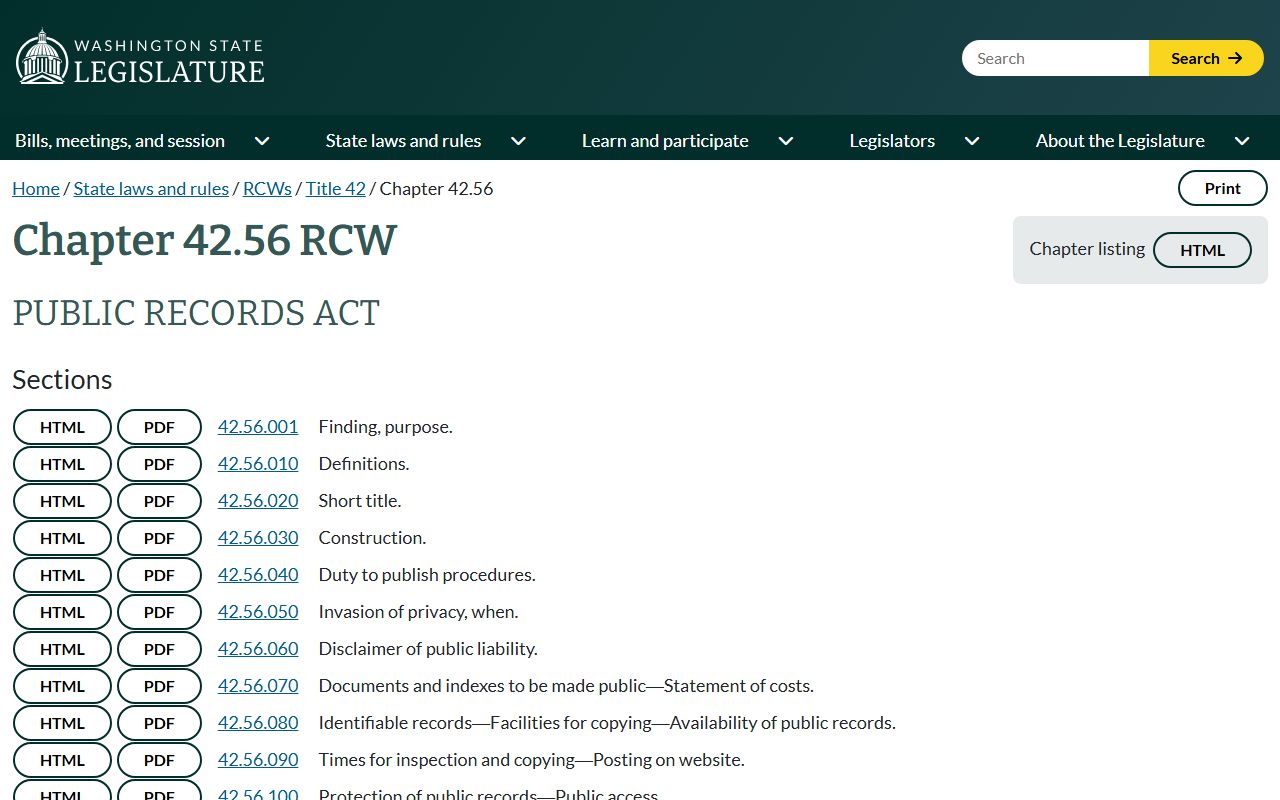
If a denial letter cites a specific section, you can look it up directly using the cite filter on that page to read the exact language the agency is relying on.
If Your Public Records Request Is Denied
A denial does not end your options. Washington law gives you several ways to challenge it. The first step is to read the denial letter carefully. It must cite the specific statute or exemption the county is relying on. If the letter is vague or cites no authority, that itself may be grounds for a challenge.
The most common paths for challenging a denial are listed below.
- Request reconsideration: You can ask the county to reconsider its decision, especially if you believe the exemption was applied too broadly or the records were not correctly identified.
- Washington Attorney General's Office: The AG publishes open-records guidance and can accept complaints about PRA violations. The AG does not adjudicate individual disputes, but guidance from the AG carries weight with agencies.
- Superior Court lawsuit: If you believe the county is wrongfully withholding records, you can file a lawsuit in Kitsap County Superior Court under the PRA. Courts can order production of records and, in some cases, award attorney fees and penalties to successful plaintiffs under RCW 42.56.550.
Before going to court, most requestors first try direct communication with the records officer. Errors and over-redactions often get corrected through that channel without litigation. The GovQA portal keeps a message log between you and county staff, which can help if you need to document a dispute.
For inmate and jail records, keep in mind that Sheriff's records requests use the Sheriff's option in the GovQA portal and are subject to the law enforcement exemptions in RCW 42.56.240. Some booking and incident-report details may be withheld for open-investigation reasons even if the record generally exists.
Kitsap County Auditor Records
The Kitsap County Auditor is a separate elected official from the Clerk. The Auditor's responsibilities include recording land records, issuing marriage licenses, recording marriage certificates, conducting elections, and handling various licensing functions. Records the Auditor holds are county agency records and fall under the Public Records Act, but the Auditor maintains its own copy request process through the auditor's office at kitsap.gov/auditor.
If you need a copy of a recorded deed, a marriage license, a marriage certificate, a survey, plat, condominium document, or map, the right office is the Auditor, not the Clerk and not the PRA portal. The Auditor's copy request form at kitsap.gov/auditor/Documents/Copy%20Request%20Form.pdf lists the document types covered and the submission address. For more on recorded documents and marriage records, see the Kitsap County Auditor page.
One practical note: all marriage records are public records under Washington law except for participants in the Address Confidentiality Program. Once a marriage application or certificate is recorded with the Auditor, it cannot be unrecorded. That is worth knowing before assuming privacy in marriage license data.