
How to Find Recently Released Kitsap County Inmates
The Kitsap Web Jail Viewer at incustody.kitsap.gov is the main public source for county jail release data. Each booking record shows a Release Date field and a Scheduled Release Date field. Both appear in the detail page for each inmate, and the results list also shows those dates as sortable columns. To look for recent releases, run a search using the wildcard character % in the name field and set a booking date range. Then sort by the Release Date column to see who moved out recently.
The Sheriff's Office warns that the data in the viewer is a jail operations record and may not be fully accurate. If a date looks wrong or is missing, call the jail directly at 360-337-7108 before acting on that information. The viewer does not offer a standalone "released today" list as a separate page. Release information lives inside the standard booking results and the individual booking detail pages. That is where you confirm whether a release has been entered and when it occurred.
A few things to keep in mind when reading the viewer results. A blank release date generally means no release date has been posted in the public roster field, not that no release planning exists. Scheduled release dates can change. Court orders, new charges, holds, sentence calculation corrections, or administrative updates all affect when someone actually walks out. The posted date is a starting point, not a guarantee.
Note: A blank release date in the Kitsap jail viewer means no date is shown in that field, not that release planning has not occurred. Scheduled dates can change based on court orders, holds, or sentence recalculation.
Setting Up Release Notifications with VINELink
VINELink is a free notification service that alerts registered users when a person's custody status changes. The Kitsap County Sheriff's jail warning page points visitors to VINELink as the preferred way to get release alerts. You can sign up at vinelink.com or call 1-877-846-3492 and search by offender name or Inmate ID. VINELink contacts you by phone, email, or text when the person you are tracking is released, transferred, or has another status change. The service is used by victims, families, attorneys, and anyone else with a need to know when a person leaves custody.
Registration takes only a few minutes. Choose Washington as the state, then search for the person by name or by the Inmate ID shown on the jail viewer. Once you locate the right record, follow the prompts to create a notification profile. You choose how VINELink contacts you and can register more than one contact method. The screenshot below shows the VINELink portal where Kitsap County alerts are set up.

From this portal, victims and families register for Kitsap County custody change alerts using an offender name or Inmate ID.
The table below shows the fields you work through in VINELink when setting up a Kitsap notification.
| Field Label | Type | Required | Notes |
|---|---|---|---|
| State | Dropdown/search | Yes | Select Washington for WA custody notifications. |
| Name / ID | Text | One required | Kitsap recommends using offender name or Inmate ID from the jail viewer. |
| Facility/Agency | Filter | Optional | Availability varies by state and agency enrollment. |
| Notification Registration | Workflow | Optional | Phone, email, or text alert options; user creates a notification profile. |
Searching State and Federal Released Inmates
The Kitsap jail viewer only covers people booked into the Kitsap County Sheriff's Office Jail. If someone was convicted of a felony and sent to a state prison, you need the Washington Department of Corrections inmate search at doc.wa.gov/information/inmate-search/. The DOC search covers people currently incarcerated in state correctional facilities and publishes information about currently incarcerated individuals for public safety. Results show the DOC Number, Name, Age, Location, and a link to register for a WA VINE notification on that person. The DOC search does not cover county jail inmates.
The table below shows the fields available on the WA DOC inmate search form.
| Field Label | Type | Required | Notes |
|---|---|---|---|
| First Name | Text | Optional | Special characters other than hyphens and apostrophes cannot be used. |
| Last Name | Text | Optional | Can search by name alone without a DOC number. |
| DOC Number | Text/Number | Optional | Search by DOC number if you have it; narrows results immediately. |
| Search Button | Submit | N/A | Returns DOC Number, Name, Age, Location, WA VINE Notification link. |
Federal inmates require a separate search. The Bureau of Prisons runs the BOP Inmate Locator at bop.gov/inmateloc/. This tool covers people in federal BOP custody from 1982 forward. If the result shows "Released" or "Not in BOP Custody," it means that person is no longer in federal BOP custody. BOP itself notes that such a result does not mean the person is free of all custody. The individual may be in another correctional or criminal justice system, in law enforcement custody, on parole, or under supervised release. The screenshot below shows the BOP locator page used to check federal release status.
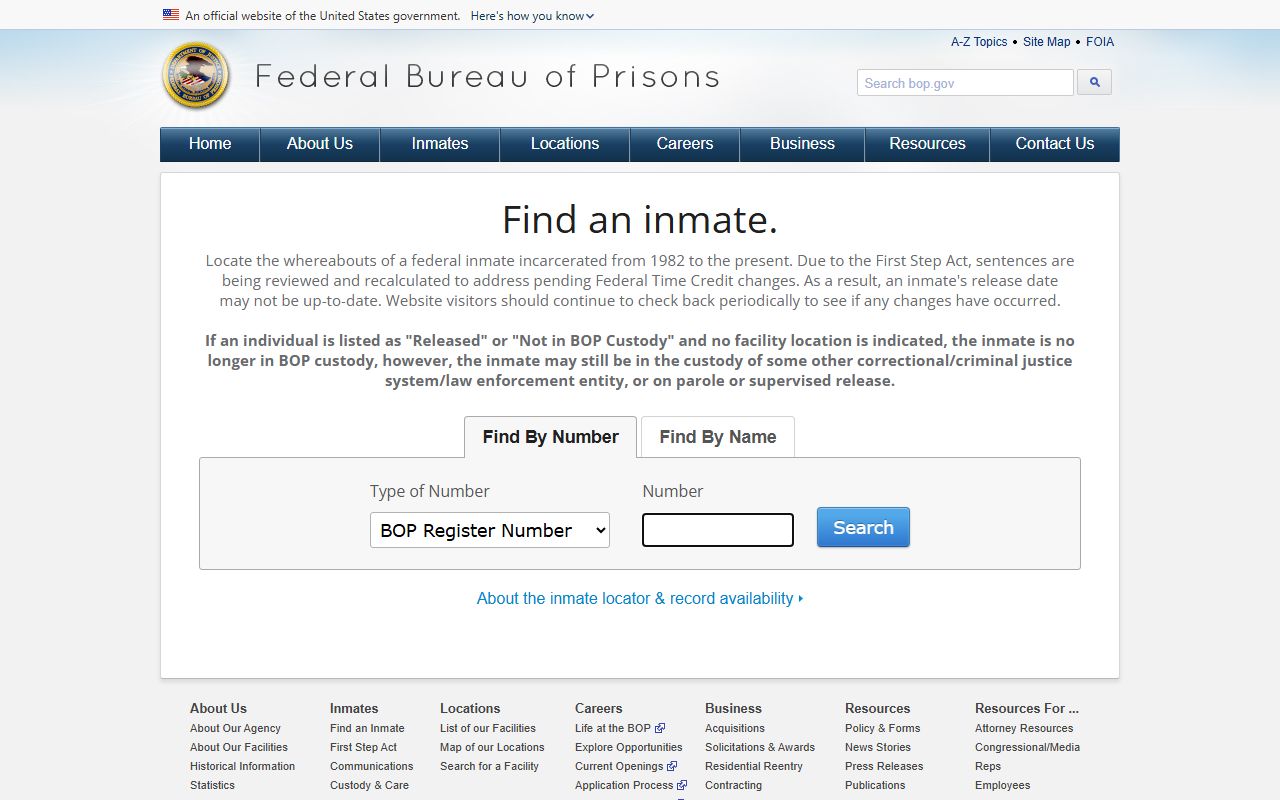
The BOP locator covers federal custody only and does not reflect Kitsap County jail or Washington state prison status.
The table below lists the search fields in the BOP locator.
| Field Label | Type | Required | Notes |
|---|---|---|---|
| Number Search | Tab/Mode | Optional | Search by BOP Register Number, DCDC Number, FBI Number, or INS Number. |
| First Name | Text | Required for name search | Used with Last Name in name-search mode. |
| Middle Name | Text | Optional | Narrows results when the first and last name are common. |
| Last Name | Text | Required for name search | Used with First Name in name-search mode. |
| Race | Dropdown | Optional | BOP standard race filter to narrow a wide name search. |
| Sex | Dropdown | Optional | Male or Female filter. |
| Age | Number | Optional | Narrows results when combined with name fields. |
A person can move between systems. Someone arrested in Kitsap may be held in county jail, then transferred to state prison after sentencing, and then placed on federal supervised release if a federal detainer is involved. Use the system that matches the custody type for that stage. If you are not sure which system holds or held someone, start with the county jail viewer, then check the DOC search, then the BOP locator.
Verifying Kitsap Release in Person or by Phone
Online databases lag behind real events. A release that happened this morning may not post to the jail viewer for hours. For urgent verification, the fastest route is a direct call. The Kitsap County Sheriff's Office Jail information line is 360-337-7108. Staff can confirm whether a person is still in custody or has been released, though they will not give out personal details beyond basic custody status.
If you need to visit the jail in person, the entry for the corrections facility is off Cline Street into the back parking lot behind the courthouse. The public entrance is different from the main courthouse door on Division Street. The jail mailing address is 614 Division Street, MS-33, Port Orchard, WA 98366. For questions about state prison inmates, contact the Washington DOC directly through the numbers listed on the DOC contact page, not through the county jail.
Kitsap County Sheriff's Office Jail
614 Division Street, MS-33
Port Orchard, WA 98366
Jail Information: 360-337-7108
The Washington Sex Offender Registry
When a person convicted of a qualifying sex offense is released from custody, Washington law requires them to register with their county sheriff within three business days of release or within three business days of coming to the county to reside, work, or attend school. The public portion of the registry is maintained by the Washington Association of Sheriffs and Police Chiefs at waspc.org/sex-offender-information. The registry is not a general release-tracking tool. It covers offenders who are required to register and whose registration is available for public disclosure at their risk level. Not every released offender appears there, and the registry should not be read as a complete record of who has been released from custody.
The screenshot below shows the WASPC sex offender information page, the official Washington gateway to the public registry.
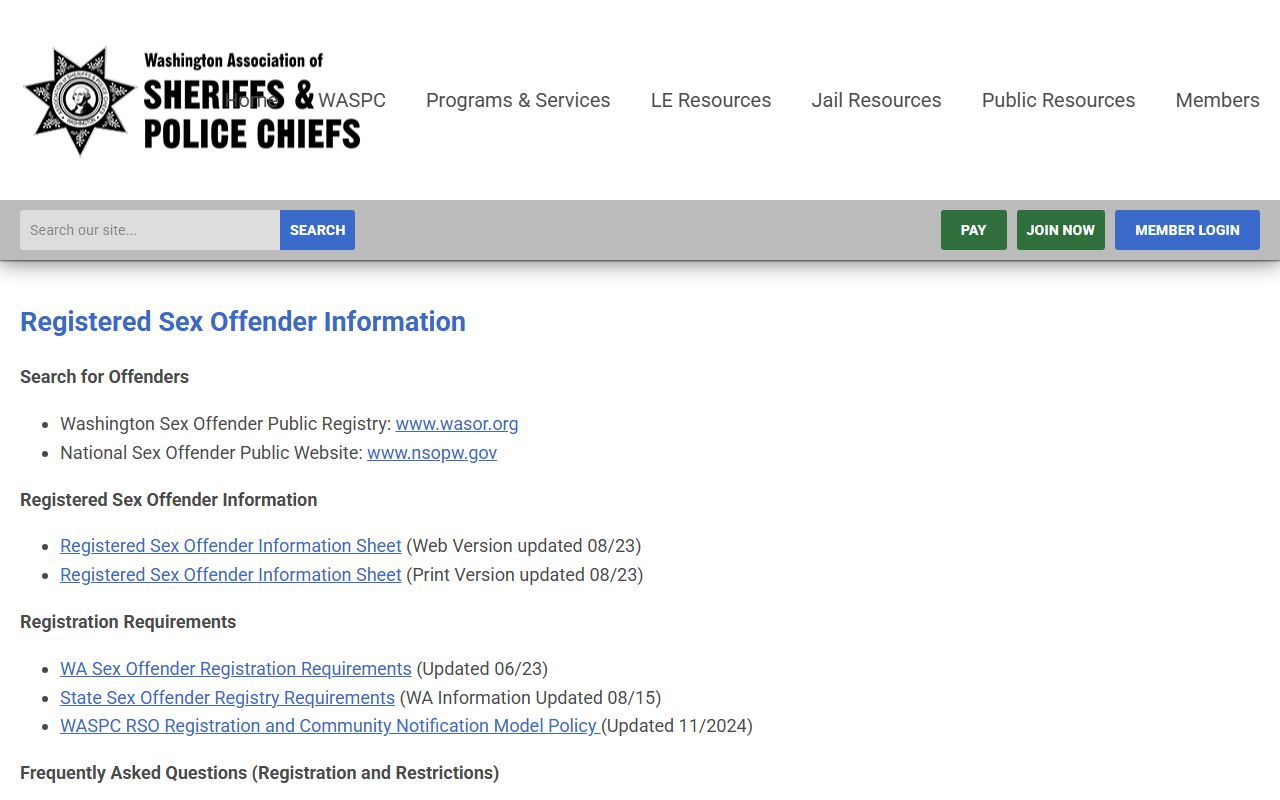
The WASPC page explains registration requirements and links the public search for registered offenders by name, address, city, county, and zip code.
The table below shows the search fields available on the Washington sex offender public registry.
| Field Label | Type | Required | Notes |
|---|---|---|---|
| Name | Text | Optional | Search by offender name; partial names may work. |
| Address / City / County / Zip | Text/Dropdown | Optional | Geographic search; exact fields vary by registry UI version. |
| Radius / Map | Map/Filter | Optional | Registry map functionality lets users search within a set distance. |
| Offender Level | Filter | Optional | Washington public registry generally focuses on published risk-level offenders; not all levels are publicly disclosed. |
Kitsap County has its own local registration enforcement. The Kitsap County Sheriff's Office is the registration authority for unincorporated Kitsap. City police departments handle registration for people who reside within city limits. If a registered offender moves to Kitsap from another county or state, they must re-register locally. The registry entry reflects the current address on file, which is the address the person reported, not necessarily where they live at any given moment.
Parole, Probation, and Reentry Resources
Most people released from Kitsap County Jail after a misdemeanor or short sentence are not placed under state DOC supervision. They may have conditions set by the court, such as no-contact orders, check-in requirements, or treatment obligations, but those are monitored through the court rather than through a state parole board. People released from a Washington state prison after a felony sentence are supervised by the Washington Department of Corrections community supervision division. DOC community corrections officers are assigned by region, and an offender released to Kitsap County would report to the DOC field office serving this area.
Washington does not use a traditional parole board for most felony releases. Under the Sentencing Reform Act, felony sentences are determinate, meaning the judge sets the length and the person serves it with good-time credit deductions. People released from state prison still have a period of community custody that functions like supervision. Conditions typically include regular reporting, substance abuse testing, and restrictions tied to the original crime. Violations go back to court and can result in a return to custody.
For people going to jail or prison and their families, the Kitsap Public Defense office links planning resources on its website. These include information about benefits and child support when someone goes to custody, AA and NA meeting schedules, the Washington DOC website, and local sentencing options. The Washington DOC and WashingtonLawHelp.org also offer statewide reentry guidance covering housing, benefits restoration, and legal-help referrals.
- Washington DOC community supervision resources at doc.wa.gov
- WashingtonLawHelp for reentry, benefits, and legal help at washingtonlawhelp.org
- Kitsap Public Defense reentry and planning links at kitsap.gov/pubdef
- Northwest Justice Project CLEAR line for civil legal aid
- Kitsap Legal Services for local civil legal assistance
The Kitsap Public Defense research notes a gap in official release-door logistics and named local reentry housing programs. The office links planning tools and state DOC resources but does not publish a local release-day transportation or housing program list on its public pages. Use the statewide DOC reentry resources and WashingtonLawHelp to find housing, benefits, and treatment referrals specific to Kitsap County.
Note: The Washington DOC community supervision division handles post-release supervision for state felony inmates. County-level supervision for misdemeanants is set through the court, not through DOC.Civil Rights Restoration After Release in Washington
Washington automatically restores voting rights when a person is released from total confinement for a felony conviction. Total confinement means the person was incarcerated in a state or local correctional facility. Once they walk out, voting rights come back. They do not need to petition a court or wait for any other order. The Washington Secretary of State's office confirms this under current state law. To vote, the person must re-register or update their registration, which can be done online or in person before the registration deadline.
Firearm rights do not restore automatically. Felony convictions result in a state and federal firearms prohibition. To restore firearm rights under Washington law, the person must petition the Superior Court in the county of conviction. The court weighs factors including the nature of the crime, the time elapsed, and the person's record since release. The Kitsap County Prosecutor's office links firearm rights restoration information. Even if the state court grants a petition, federal law may still apply, so consult an attorney before assuming any restoration is complete.
Employment rights after release are shaped by both state law and the specific job or license being sought. Washington has laws limiting how employers can use conviction records in hiring decisions, but those rules vary by employer type and job category. For professional licenses, the Washington Department of Licensing sets rules by license type. Legal aid resources like WashingtonLawHelp and the Northwest Justice Project can advise on the specific rights and limits that apply after a Kitsap felony or misdemeanor conviction.
- Voting rights
- Automatically restored upon release from total confinement under current Washington law. Re-register to vote after release.
- Firearm rights
- Not automatic. Requires a Superior Court petition in the county of conviction. Federal law may still apply even after a state court grants restoration.
- Employment rights
- Washington limits how employers can use conviction records, but rules vary by employer type and license category. Check with an attorney or legal aid for specifics.
- Professional licensing
- License-by-license rules apply through the Washington Department of Licensing. A felony conviction may bar some licenses but not others.