
Kitsap County Arrest Records and the Web Jail Viewer
When someone is arrested and booked into the Kitsap County Sheriff's Office Jail, a booking record is created. That record becomes part of the public jail roster, which the Sheriff makes available through the Web Jail Viewer at incustody.kitsap.gov. The tool is free to use, and no login is required after passing through the warning screen. The Sheriff's warning states the information is provided by the jail and may include personal descriptive information and the offenses charged by the arresting agency. The data may not be fully accurate, and users who believe something is wrong should contact the jail directly at 360-337-7108.
The viewer is the fastest source for recent Kitsap County arrest records. It shows who is currently in custody and who has been recently released. The booking date tells you when the arrest brought a person to the jail. The charges listed are what the arresting agency reported at the time of booking. Those charges can change later as prosecutors review the case and decide what to file in court.
The screenshot below shows the booking search form at the Web Jail Viewer, which is where a Kitsap County arrest records search begins.
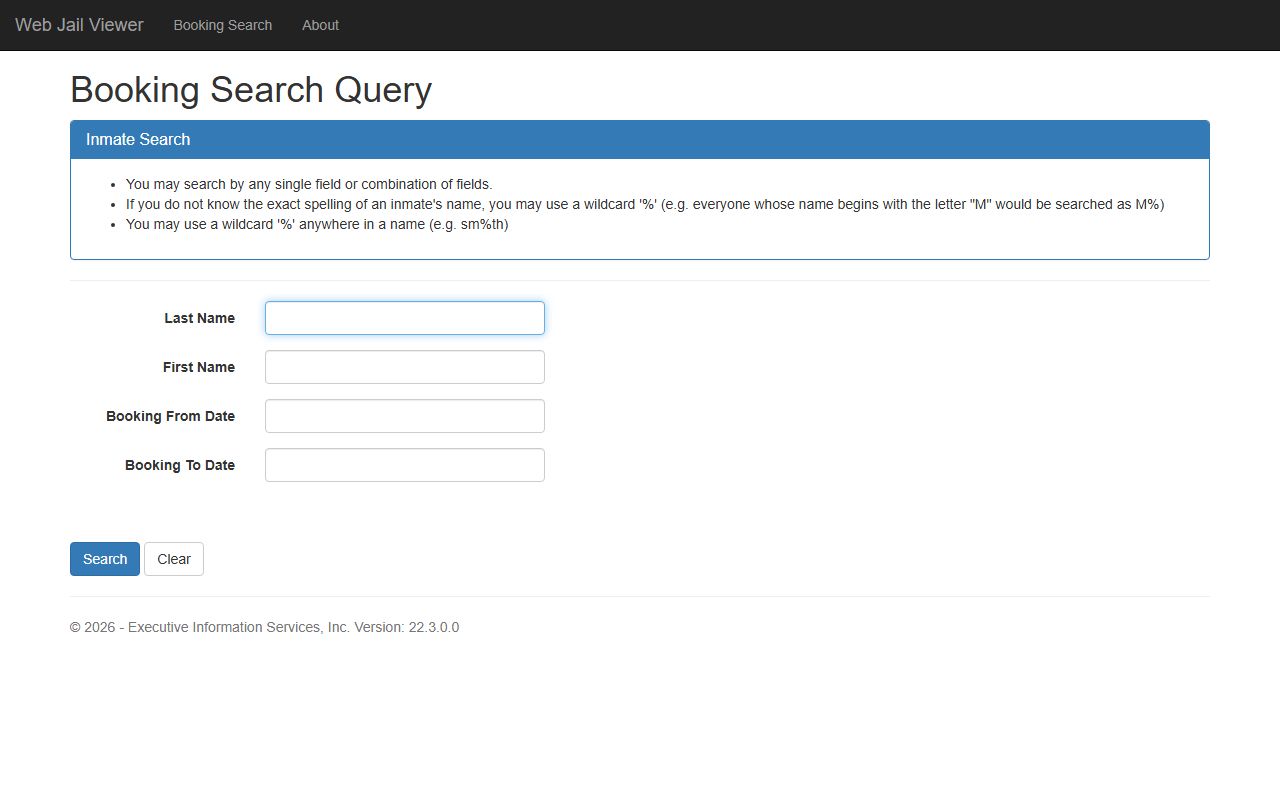
The form accepts last name, first name, and a date range. You can use any one field or combine them for a tighter result. Wildcards are covered in the next section.
How to Search Kitsap County Arrest Records Online
The booking search form at the Web Jail Viewer is straightforward, but knowing the search fields and tips saves time. The table below lists every field on the form and notes how each one works.
| Field | Type | Notes |
|---|---|---|
| Last Name | Text (max 20) | Use % as a wildcard anywhere, e.g. "SM%TH" for partial spellings. |
| First Name | Text (max 20) | Optional; wildcard % allowed in any position. |
| Booking From Date | Date picker | Format mm/dd/yy; leave blank to search all dates. |
| Booking To Date | Date picker | Pair with Booking From to narrow a date range. |
| Search button | Submit | Runs the query and shows a spinner while loading. |
| Clear button | Reset | Clears all fields at once. |
Results appear in a sortable list with columns for booking number, name, race, sex, booking date, release date, and scheduled release date. Click any blue column header to sort. When results run long, pagination links let you step through pages. A broad wildcard search like "%" returns everyone in the system, which can produce many pages; narrow by name or date when you can.
To open an individual arrest record, click the view icon or the booking number link in a result row. The detail page shows the full booking profile, including charges, arrest agency information, court type, next court date, and bond or bail fields.
- Go to incustody.kitsap.gov, read the warning notice, and click the Access Site button.
- Click Booking Search in the navigation to open the search form.
- Enter a last name, first name, or date range, or any mix of the three. Use % as a wildcard if you are unsure of spelling.
- Click Search and wait for the results list to load.
- Click the view icon or booking number for the person you want to see the full arrest detail.
If a name or date returns no results, try a broader search. A person who was arrested and quickly released may still show in results with a populated release date. Someone not found here may be in state prison, which is a separate Washington DOC system, or may not have been booked at the Kitsap County facility.
What a Kitsap Arrest Record Shows
A public booking detail on the Kitsap Web Jail Viewer holds several categories of information. The header shows the person's full name and current custody status. Below that, identifying numbers, dates, and a physical description section appear. Charges are listed in their own panel with fields for the statute or code, charge level, and related court and bond details.
The fields a reader will encounter on a public Kitsap arrest record are listed below. This inventory is based on a detail page inspected from the live viewer on May 27, 2026. Live data changes constantly, so some fields may be blank on any given profile depending on the stage of the case.
- Name and custody status - full name displayed, with a status button such as "IN CUSTODY as of" a recent date.
- Booking Number - unique booking ID assigned at intake, for example 2026001506.
- Inmate ID - a separate person-level ID, for example 50000014.
- Booking Date - the date the person was brought to the jail.
- Scheduled Release and Released - planned and actual release dates if populated.
- Personal Description - age, sex, race, hair, eyes, height, and weight.
- Charges panel - violation code with RCW or ordinance reference, short description, charge level (examples: FC, FB), arrest agency, case number, and arrest date.
- Court and Bond - court type (example: SC for Superior Court), court case number, next court date, required bond type (examples: C/B, RF, GL), bond group number, required bond amount, and required cash amount.
One important note: the inspected public detail did not show a booking photo or mugshot. The physical description fields replace what many people expect to see as a photo. The jail system may change, but do not assume a mugshot will be visible on any given profile.
Social Security numbers, dates of birth, home addresses, and financial account numbers do not appear in the public booking detail. Court rules and privacy law keep those fields out of public view.
Note: A booking record reflects what the arresting agency reported at intake. Charges can change after prosecutors review the case. Always confirm current case status through court records before relying on a booking charge.
Arrest Records vs. Criminal Court Records in Kitsap County
Many people use "arrest records" and "criminal records" as if they mean the same thing. They do not. An arrest record starts the moment a person is booked into jail. A criminal court record starts when charges are formally filed with a court. The two tracks are maintained by different offices, live in different databases, and reflect different stages of the legal process.
For Kitsap County, the Sheriff's Office creates and maintains booking records through the jail system. The Kitsap County Clerk maintains Superior Court criminal case files for felonies. The Kitsap County District Court ePortal holds misdemeanor and gross misdemeanor case files. Neither the Clerk nor District Court publishes a real-time arrest blotter; that is the jail viewer's job. For full criminal case history, the court records page covers both Superior Court and District Court search paths.
| Arrest Record | Criminal Court Record | |
|---|---|---|
| Maintained by | Sheriff's Office Jail | Clerk (felony) / District Court (misdemeanor) |
| Created when | Person is booked into the jail | Charges are filed by the Prosecutor |
| Primary contents | Booking number, charges at booking, bond, physical description | Pleadings, motions, dispositions, sentencing orders |
| Where to search | incustody.kitsap.gov | Digital Archives / District Court ePortal / Washington Courts |
| Mugshots visible | Not visible in inspected public pages | Not part of court case files |
| Conviction shown | No; charges only | Yes; disposition and sentencing if entered |
The research note for this page says it plainly: a jail booking is not a conviction. The viewer shows charges by the arresting agency and court or bond fields, but criminal history and background checks are maintained by Washington State Patrol, and final case outcomes must be confirmed through court records.
Charges vs. Convictions in Kitsap County Criminal Cases
Being charged with a crime is not the same as being convicted. A charge is an allegation. A conviction is a finding of guilt, whether by verdict at trial or by a guilty plea accepted by the court. The difference matters because a person can be charged, held in the jail for a period, and then have the charge dropped, reduced, or result in an acquittal. The booking record may persist in the jail viewer long after the outcome is different from what the initial charge suggested.
Felony charges in Kitsap County are reviewed and filed by the Office of the Prosecuting Attorney under Chad M. Enright, who serves through December 2026. The Prosecutor's Office decides which charges, if any, to file in Superior Court after law enforcement refers a case. Misdemeanor and gross misdemeanor charges go through the Prosecutor as well for county law enforcement referrals and for the contracting cities of Bainbridge Island, Poulsbo, and Port Orchard.
The screenshot below shows the Kitsap County Prosecutor's homepage, which publishes information on case status, charge questions, and the office's divisions.
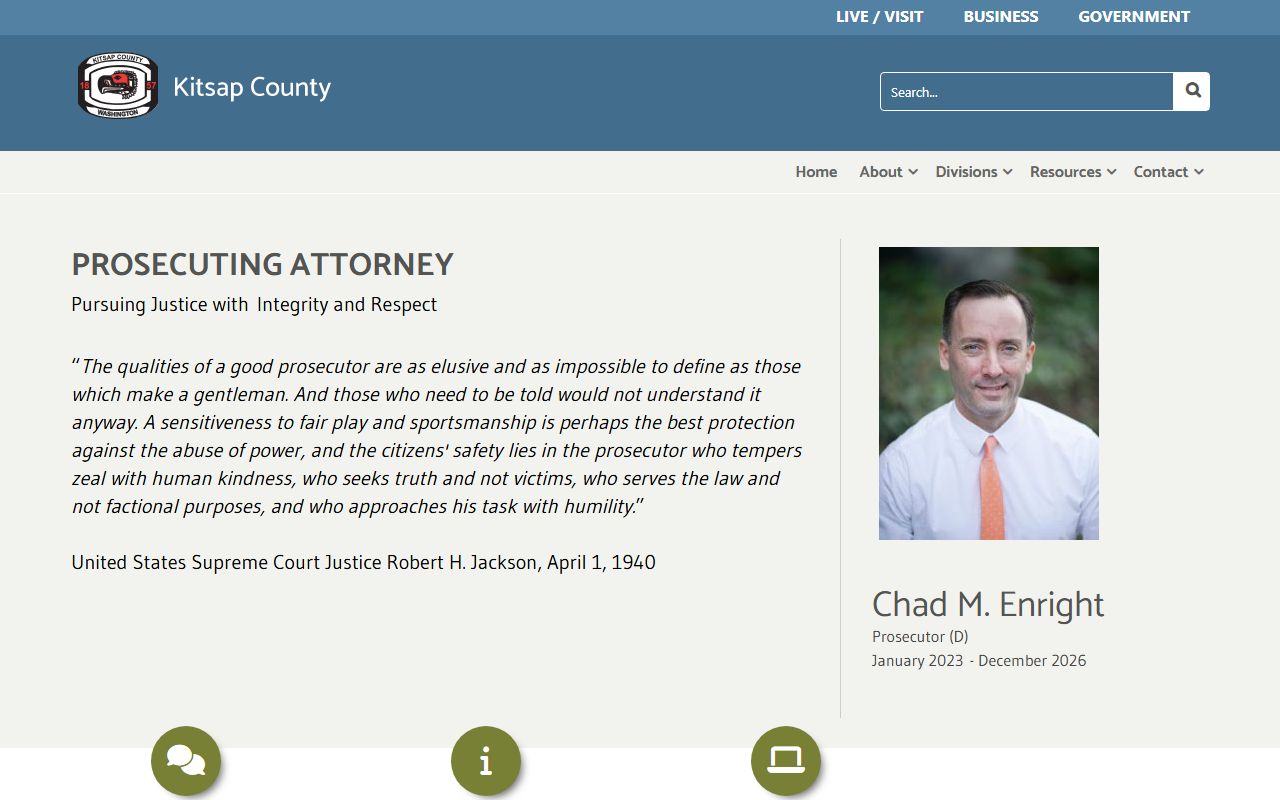
The Prosecutor cannot give legal advice to the public under Washington Rules of Professional Conduct, but the office does publish resources on case status and charge questions through its website.
| Charge | Conviction | |
|---|---|---|
| What it is | Formal allegation of a crime | A finding or plea of guilty accepted by the court |
| Standard | Probable cause to believe crime occurred | Proof beyond a reasonable doubt (trial) or valid guilty plea |
| Who decides | Prosecutor files after law enforcement refers case | Judge or jury (trial) or judge accepting a plea |
| Shows in booking? | Yes, as charges entered by arresting agency | Not shown in booking record |
| Shows in court record? | Yes, in charging document | Yes, in disposition and sentencing entries |
| Public access | Yes, through jail viewer and court file | Yes, through court record; some vacated convictions limited |
If you see a charge on a Kitsap booking record, look up the case in the court system to find out whether charges were ever filed and what the outcome was. A charge with no matching court case may mean the case was declined by the Prosecutor or is still under review.
Juvenile Arrest Records and Restricted Kitsap Records
Not all Kitsap County arrest and criminal records are public. Juvenile records are the most significant category with broad restrictions. The Kitsap Juvenile Court page is direct: diversion records and social files are confidential, and no information can be given about whether such a record exists unless RCW 13.50 allows it. Official juvenile court file records are court orders maintained by the Clerk, but even those have access limitations based on juvenile-record law and court rules.
The screenshot below comes from the Kitsap County Juvenile Court records page and the Washington State Patrol criminal history section, both of which explain the difference between confidential diversion files and the court orders the Clerk keeps.
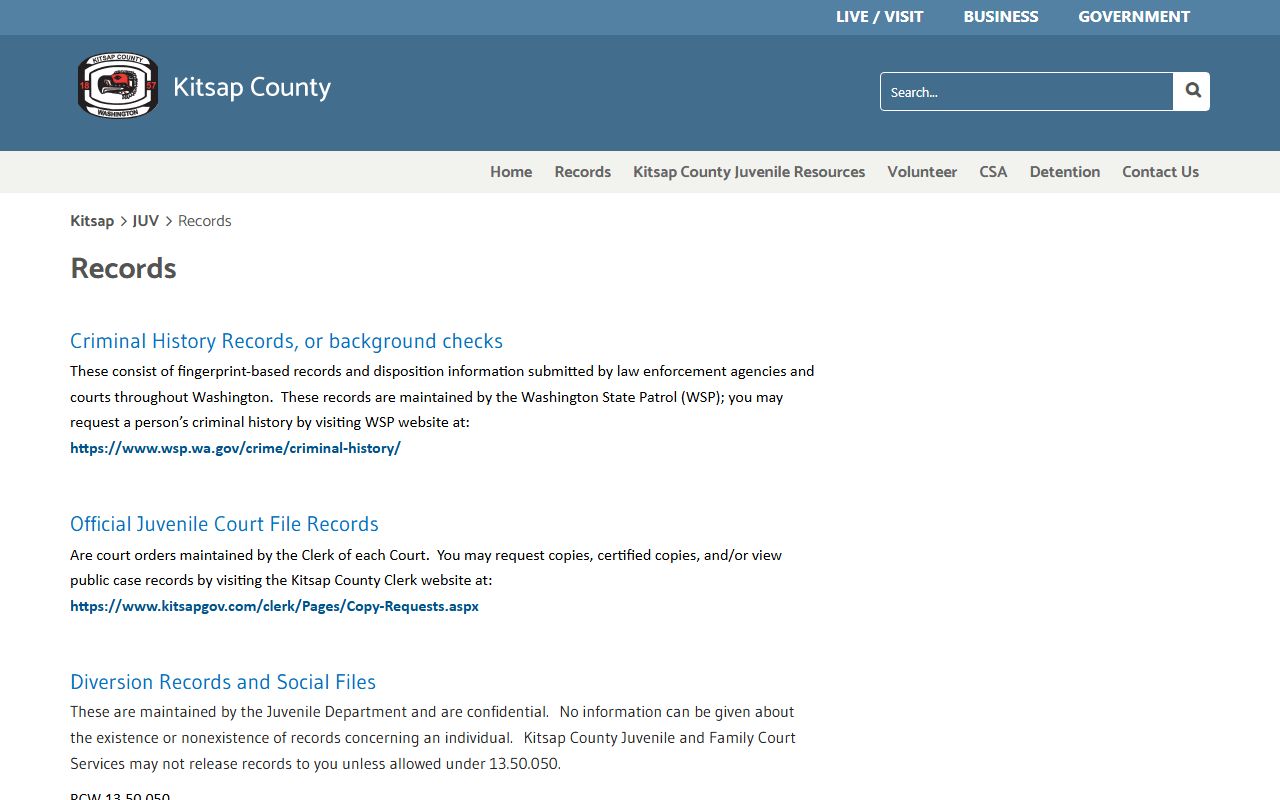
The page directs criminal history and background check requests to Washington State Patrol, which maintains fingerprint-based records statewide under chapter 10.97 RCW, the Criminal Records Privacy Act.
Other restricted categories in Kitsap County include sealed court records blocked by order under court rule GR 15, adoption records restricted by chapter 26.33 RCW, active-investigation materials exempt under RCW 42.56.240, mental health records protected by state and federal health-privacy law, and personal identifiers removed from court filings under GR 22. If a record is sealed, a reader may need to petition the court that handled the case and demonstrate grounds to access it.
Sealed Records vs. Vacated Convictions in Washington
Washington does not use the word "expungement" for most adult conviction relief. The state uses "vacation of conviction," a legal process that withdraws certain conviction records from public access and from many background check databases. Vacation is not automatic. A person files a petition in the court where the case was handled, serves the Prosecutor, and shows the court that all eligibility requirements are met. The Kitsap Office of Public Defense links resources for sealing and quashing records, which is a good starting point for someone exploring these options.
| Sealed Record | Vacated Conviction | |
|---|---|---|
| Washington term | Sealed (court order under GR 15) | Vacation of conviction (RCW 9.94A.640 or RCW 9.96.060) |
| Effect | Record hidden from public view; may still exist in court system | Conviction withdrawn; person may say arrest did not result in conviction |
| Law enforcement access | Limited; court may retain internal record | Agencies may retain record; some limits on use |
| Eligibility | Set by GR 15 and specific statute or court order | Offense type, sentence completion, waiting period, no new convictions, no pending charges |
| Who decides | Court on petition or motion | Court on petition; Prosecutor served and may respond |
| Automatic? | No | No; petition required |
Felony vacation in Washington is governed by RCW 9.94A.640. Misdemeanor and gross misdemeanor vacation runs under RCW 9.96.060. Juvenile sealing follows a separate process under chapter 13.50 RCW. Eligibility depends on the offense, the sentence completed, any waiting period required by law, and whether new charges or convictions exist. Not every offense can be vacated; some categories are excluded by statute.
The vacation process clears certain public-facing effects of a conviction but does not necessarily erase every underlying agency record. Washington Courts provides forms and interview tools to walk through vacation eligibility. Public Defense also links resources for people in Kitsap County who want to pursue relief.
Note: GR 15, the Washington court rule governing destruction, sealing, and redaction, is the authority for sealing court records by court order separate from the vacation process.
Washington State Patrol Criminal History and Background Checks
Fingerprint-based criminal history records for Washington are held by Washington State Patrol, not by Kitsap County. The Kitsap Juvenile Court page makes this clear, stating that criminal history and background check records are maintained by Washington State Patrol and directing both the public and service agencies there for those requests. This is important for anyone who needs a formal criminal history report rather than a quick jail roster check.
The WSP maintains criminal history under chapter 10.97 RCW, the Criminal Records Privacy Act. That chapter governs who can request criminal history, what can be disclosed, and under what circumstances restricted criminal records can be accessed. Dissemination rules differ for law enforcement, employers in regulated industries, and members of the general public. A self-request lets a person see their own record.
The Kitsap Web Jail Viewer and court portals show booking or case data at the county level. WSP criminal history is a statewide fingerprint-based record built from law enforcement submissions across Washington. The two sources may contain different information and serve different purposes. A background check for employment, licensing, or housing typically means a WSP criminal history request, not a county jail viewer search.
Important: This site is not a consumer reporting agency under the Fair Credit Reporting Act. Information shown here cannot be used for credit, employment, tenant screening, insurance, or other FCRA-regulated decisions.
Kitsap County Public Defense for Criminal Charges
A person charged with a crime in Kitsap County who cannot afford an attorney may qualify for representation through the Office of Public Defense. The office provides client-focused representation under Washington law for people who meet the indigency standard. Staff attorneys handle many cases directly, and cases outside the staff's capacity are assigned to qualified local attorneys with experience in the relevant case type.
Public Defense handles felonies, misdemeanors, juvenile matters, dependency cases, and civil contempt proceedings where liberty or parental interests are at stake. The office is not available for civil lawsuits or general legal questions unconnected to those case types. For civil legal aid, Kitsap Legal Services, the Northwest Justice Project CLEAR line, and WashingtonLawHelp are separate resources linked by the Clerk.
The screenshot below shows the Public Defense eligibility and qualifying case types page.
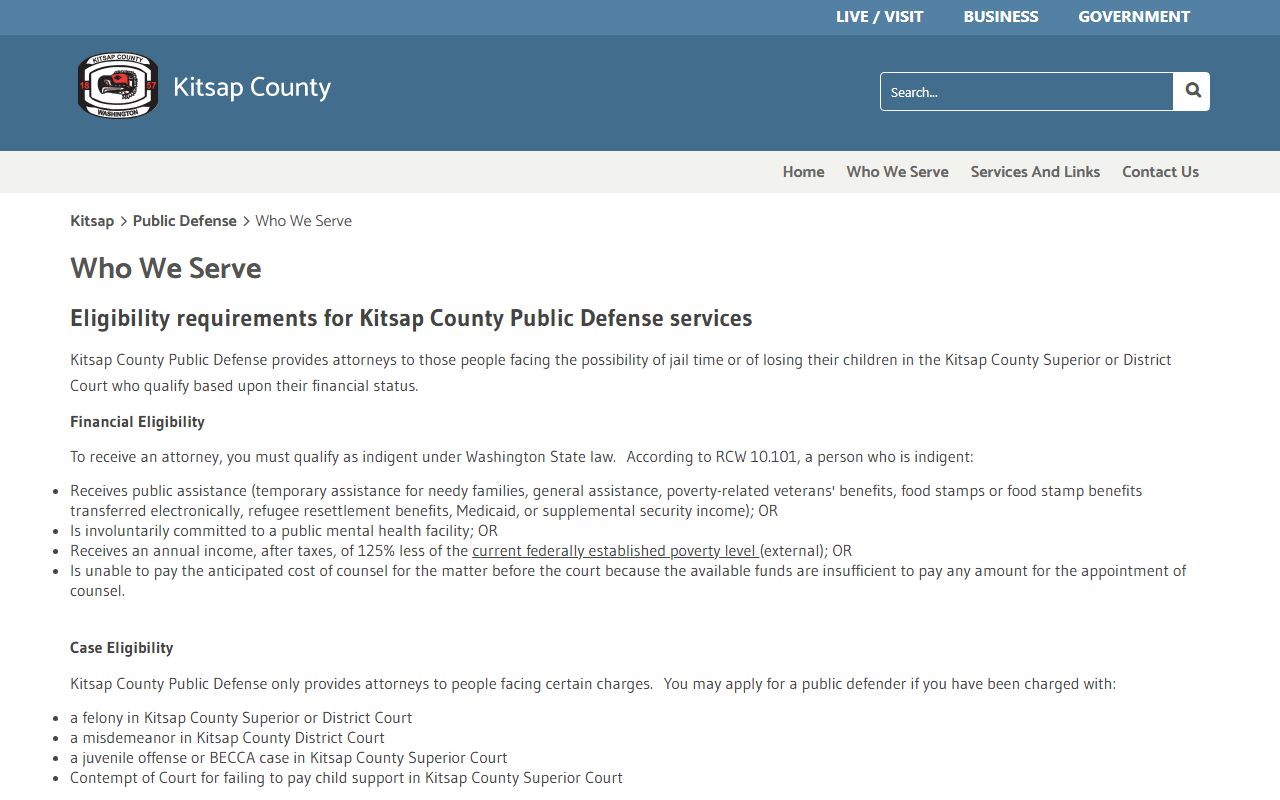
The page explains which case types qualify, how to find out who your public defender is, and how to ask about available sentencing options, including specialty courts.
Office of Public Defense
614 Division Street, Room 103
Port Orchard, WA 98366
360-337-7015
Mon-Fri 8:00 a.m.-4:30 p.m. (closed 12:00-1:00)
Public Defense also links resources for people dealing with warrants. If you have a felony bench warrant, the office publishes a quash-warrant resource on its website. Active warrants appear as a "War.#" field on individual booking profiles in the jail viewer. For more on warrants, see Kitsap County warrant records.
Specialty Courts and Arrest Records
Kitsap County runs several specialty courts that can affect how a criminal arrest record develops. The District Court Behavioral Health Court accepts eligible participants who have mental illness or co-occurring disorders. It began in November 2016 and uses a team-based, non-adversarial approach that includes defense attorneys, prosecutors, the jail, treatment providers, and behavioral health outreach. Participation is voluntary and eligibility is screened through the court and attorney channels, not a direct walk-in process.
Superior Court runs an Adult Drug Court and a Veterans Treatment Court. Both use a collaborative therapeutic model and connect participants with treatment, the Sheriff's Office, Veterans Services, and community partners. These programs can influence the final disposition of a criminal case, which affects what the court record shows as the outcome. A person who completes a specialty court program may have a different criminal record result than someone whose case went through the standard track.
Specialty court records follow the same access rules as other Superior Court or District Court files. They are not automatically sealed by participation. For more on how the full court record system works, see Kitsap County court records.