
About the Kitsap County Clerk's Office
The Clerk of the Superior Court is an elected position under the Washington State Constitution. The Clerk is also the financial officer for Kitsap County Superior Court. That means the office does more than hand over copies. It collects statutory fees and fines, handles victim restitution, and manages the court trust account. When a case ends with a money judgment, the Clerk records the financial outcome as part of the official court file.
One phrase from the Clerk's own page stands out: the office preserves court documents "in perpetuity." That word matters. A divorce decree from thirty years ago, a probate order from a closed estate, or a felony judgment from a case that wrapped up decades back should still be traceable through the Clerk. The physical image may live in the Washington State Digital Archives, but the Clerk's office remains the custodian of record. That is why copy requests and certified-copy orders route through the Clerk rather than through a separate archive office.
The Clerk is also present at every court hearing as an independent witness. The office creates the hearing minutes and keeps exhibits entered by the parties. Those minutes become part of the case record. The Clerk also serves as Jury Commissioner for all Kitsap County courts, covering Superior Court, District Court, and municipal courts. And the office performs quasi-judicial functions: it can issue writs, warrants of arrest, and letters testamentary without a judge signing each one individually.
Kitsap County Clerk
614 Division Street, Room 202
Port Orchard, WA 98366
360-337-7164
Mon-Fri 8:00-12:15 and 1:15-4:30
Closed court holidays
The Clerk is on the second floor of the courthouse at 614 Division Street in Port Orchard. Room 202 is right above the District Court on the first floor. If you are visiting the same day you have a hearing, plan the sequence ahead: the Clerk closes at 12:15 for lunch and reopens at 1:15, so a filing or copy pickup before a 1:30 hearing may be tight.
What the Kitsap County Clerk Handles
The Clerk manages files for every category of Superior Court case. Criminal felony files, civil and family law files, probate and guardianship files, juvenile matters, paternity, and adoption cases all route through this office. When a new case is filed, the Clerk assigns a case number, stamps documents, and opens the official file. When documents are added later, the Clerk dockets each one so the record stays complete.
The Clerk's homepage on the county site shows the official page for the office. The screenshot below links to that page and shows the copy request, forms, FAQ, and pro se sections that members of the public use most.
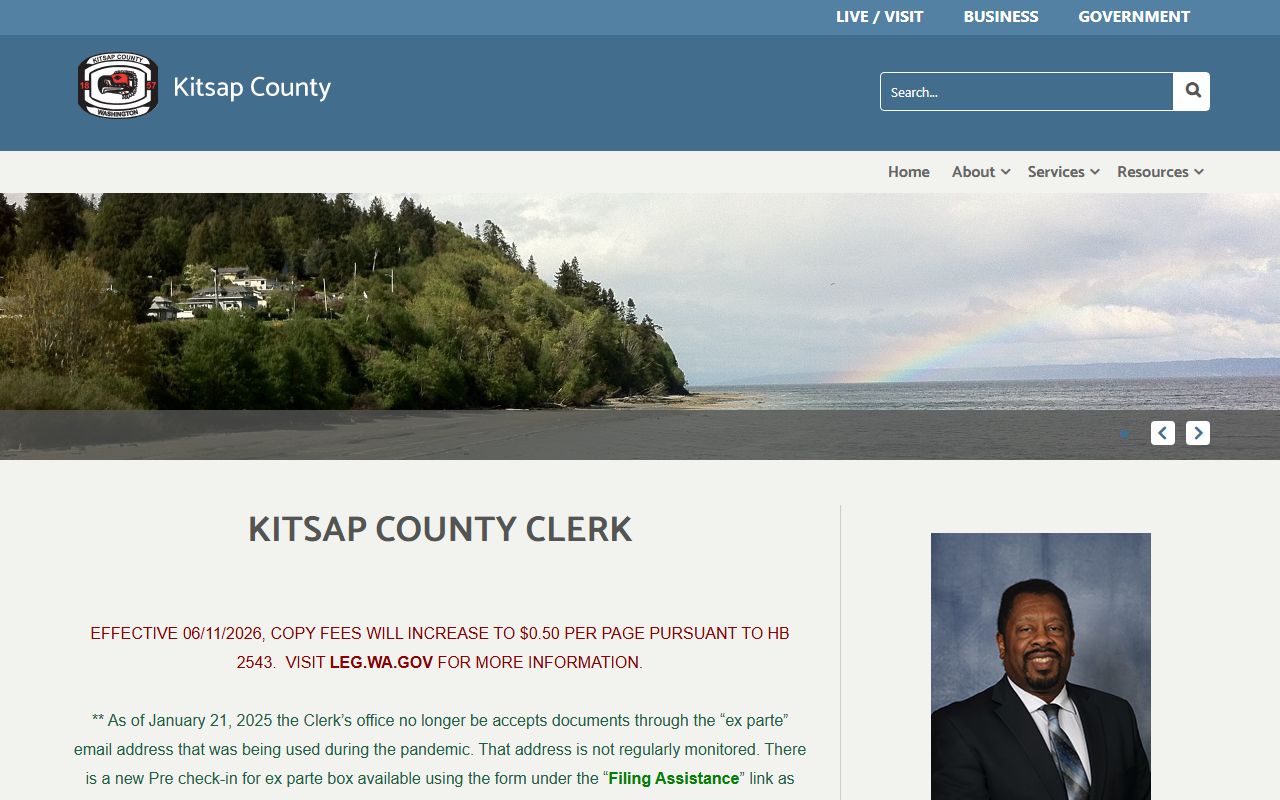
From the Clerk homepage you can reach the copy request form, the FAQ page, the forms and kits list, and the ex parte pre-check-in instructions that replaced the old pandemic-era email workflow in January 2025.
Beyond filing and records, the Clerk handles several functions people do not always expect from a records office:
- Issues writs, warrants of arrest, and letters testamentary as quasi-judicial functions.
- Serves as Jury Commissioner for Superior Court, District Court, and municipal courts.
- Creates the official minutes of every Superior Court hearing.
- Manages the court trust account, statutory fees, fines, and victim restitution payments.
- Maintains exhibits entered by parties at hearings.
One thing the Clerk does not handle: marriage licenses. Those are issued by the Kitsap County Auditor, a separate elected office. If you need a marriage license or a copy of a marriage certificate, see the County Auditor page for that office's process. Divorce records, on the other hand, are Superior Court filings and live with the Clerk.
Note: The Clerk no longer accepts documents through the pandemic-era ex parte email address as of January 21, 2025. A new pre-check-in process applies to ex parte hearings.
Kitsap Clerk Copy Services Explained
The Clerk offers three distinct copy services. Each has its own fee structure and delivery path. Mixing them up is a common mistake, so it helps to know which one you need before you submit a request.
The first service is electronic court documents. These are image files of case documents stored in the Washington State Digital Archives or the Odyssey system. The general public uses Digital Archives. Attorneys and businesses that need frequent document access use the Odyssey Portal, which is subscription-based and not intended for one-off public use. For Digital Archives access, the Clerk instructs users to choose "Superior Court Records" as the record series, select Kitsap County in the county dropdown, and enter the case number with dashes. The list of documents for that case then appears under "Description."
The second service is audio recordings of court hearings. The Clerk's copy request page explains that audio and certified text transcripts are different things. If a hearing was digitally recorded, you can buy the audio before deciding whether to order a typed transcript from a court transcriber. Not every hearing has a digital audio file; some were reported by a court reporter instead. If no audio is found after the deputy clerk reviews the request, the office issues a refund. If audio for that hearing is sealed or confidential, the requestor must appear in person with a government-issued photo ID. Digital download links are emailed to the address on file and expire 30 days after being sent. The Clerk's page points users to the free FTR Player at fortherecord.com to listen to downloaded recordings.
The third service is authenticated and exemplified copies. An authenticated copy is a document or record verified by the court seal. An exemplified copy goes further: it has a sworn authenticity statement from the clerk, an additional sworn authentication of the clerk's signature by the judge, and the court seal stamped through all copies including the sworn statements. The Clerk notes that exemplified copies are often required when a document will be filed in another state or country, for example when a divorce decree must be recognized in a foreign jurisdiction.
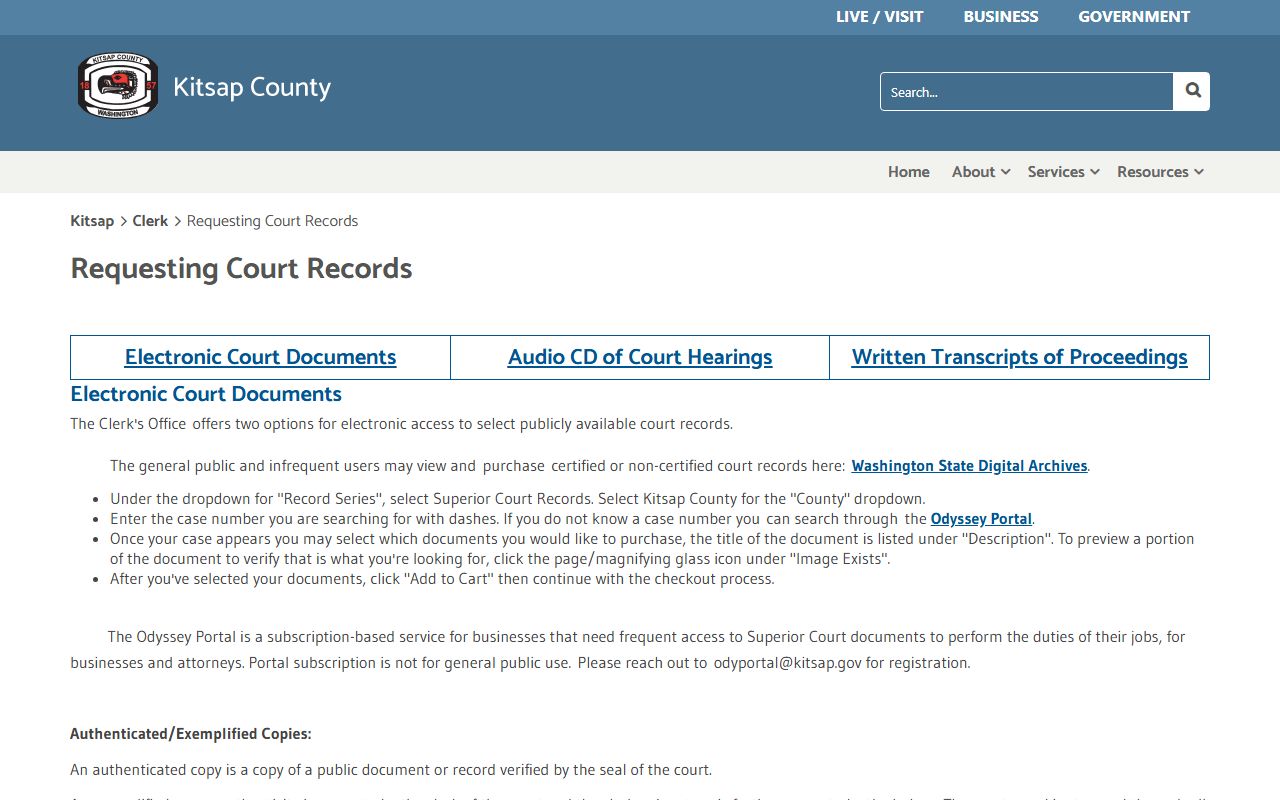
The Clerk's electronic copy request page walks through the Digital Archives checkout process step by step, including how to preview a document image before purchasing it.
Kitsap County Clerk Fee Schedule
The table below comes from the Clerk's FAQ and copy request pages. Fees cover both document copies and audio recordings of court hearings. Card payments carry a minimum $2 fee or 2.4% of the transaction, whichever is higher. The Clerk accepts cash, money order, and cashier's check; personal checks are not accepted.
One important upcoming change: the Clerk's homepage announces that regular copy fees will rise to $0.50 per page on June 11, 2026, under HB 2543. The current rate of $0.25 applies until that date.
| Item | Amount | Notes |
|---|---|---|
| Non-certified copy (electronic/imaged records) | $0.25 per page | Increases to $0.50/page on June 11, 2026 (HB 2543). |
| Certified copy | $5 first page + $1 each additional page | Per document. Includes the certification stamp. |
| Mail request surcharge | +$5 | Added to any copy order fulfilled by mail. |
| Request requiring research | $30 | Applies when the Clerk must research to locate the record. |
| Authenticated/exemplified copy | $9 first page + $1 each subsequent page | Required for filings in other states or countries. |
| Audio recording (regular, pickup or digital download) | $25 per hearing day | 3-5 business days processing. |
| Audio recording (regular, mailed) | $30 per hearing day | Includes $5 mailing fee. 3-5 business days. |
| Audio recording (expedited, pickup or digital download) | $45 per hearing day | 1-2 business days processing. |
| Audio recording (expedited, mailed) | $50 per hearing day | 1-2 business days plus mailing. |
| Fax filing (WSBA members only) | $5 first page + $1 each additional page | 20-page limit excluding cover sheet. Only documents with no filing fee. |
| Divorce/dissolution filing | $364 | Full filing fee for a new dissolution case. |
The legal framework for copy fees is RCW 36.18, which sets the schedule of fees the Clerk must collect. The Clerk's administrative records, such as policy documents and procedures, follow a separate access rule under GR 31.1 rather than the case-file copy fee schedule. For court records access law generally, the county points to court rules and common law rather than the Public Records Act. A full breakdown of access law is on the public records page.
How to Request a Certified Copy in Kitsap County
Certified copies are required when a court document must be used in a legal proceeding, submitted to a government agency, or accepted in another jurisdiction. A plain copy serves everyday reference needs. An exemplified copy is needed when the document goes to another state or country. Here is the standard path for a certified copy request from the Kitsap County Clerk.
- Identify the case number. The case number format for Kitsap Superior Court looks like "11-2-00123-4" (year, cause-type digit, sequence, check digit). You can look up a case number using the free Washington Courts case search at dw.courts.wa.gov or by checking a previous court document.
- Locate the document you need. Go to the Washington State Digital Archives, choose "Superior Court Records" as the record series, select Kitsap County in the county dropdown, and enter the case number with dashes. Document titles appear under "Description." The magnifying-glass icon under "Image Exists" lets you preview part of the document before you order.
- Choose your copy type. Decide whether you need a non-certified copy ($0.25/page), a certified copy ($5 first page + $1 each additional), or an authenticated/exemplified copy ($9 first page + $1 each subsequent page). If the document will be filed in another state or country, ask for exemplified.
- Submit the request to the Clerk. You can request in person at Room 202, by mail, or through the copy request page on the Clerk's website. Mail requests add $5. Include the case number, party names, document type or description, and the number of copies you need.
- Pay the fee. The Clerk accepts cash, money order, or cashier's check. Cards carry a minimum $2 fee or 2.4% of the transaction. Personal checks are not accepted.
- Receive your copy. In-person requests can often be filled the same day if the image is in the system. Mail requests may take longer depending on volume. Research requests that require the Clerk to locate a record cost $30 and take additional time.
If you need a transcript of a court hearing rather than a copy of a filed document, the process starts with the audio recording. Buy the audio file first, then work with a court transcriber to produce the typed text. The Clerk does not produce transcripts directly.
Records Request Form Fields
The Clerk and District Court use different request forms for different record types. The table below shows the field inventory for the District Court administrative records request form, which is also the model for administrative record requests across Kitsap courts under GR 31.1. Superior Court case document requests go through the Digital Archives or through the Clerk's copy request page, where you provide similar identifying information.
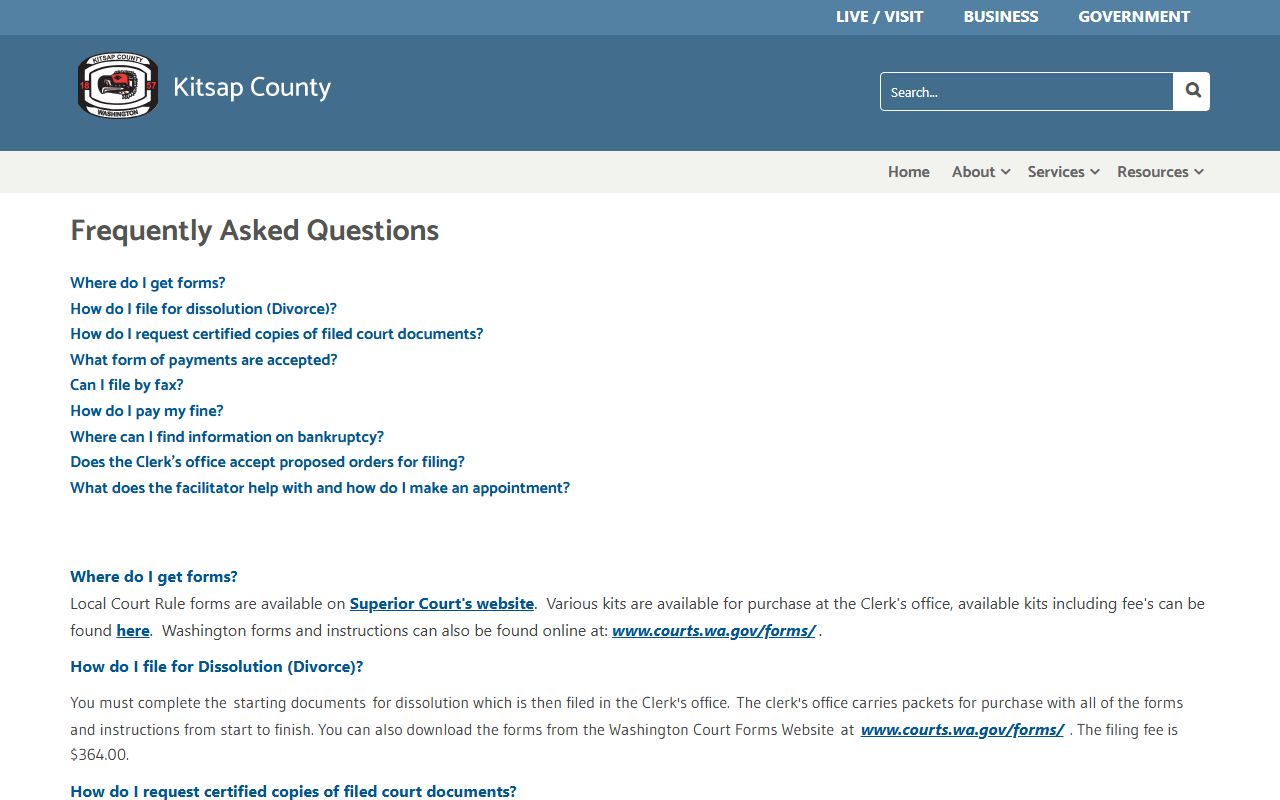
The Clerk's FAQ page, shown above, links the copy request instructions and answers the most common questions about record formats, fees, and processing times.
| Field Label | Type | Required | Notes |
|---|---|---|---|
| Request type: Inspect records | Checkbox | Select one | Choose inspect or copies; both can be selected. |
| Request type: Copies | Checkbox | Select one | Choose inspect or copies; both can be selected. |
| Printed Name | Text | Yes | Last, First, Middle Initial format. |
| Mailing Address | Text | Yes | Street, City, State, Zip. |
| Telephone: Home | Phone | Optional | Area code and number. |
| Telephone: Cell | Phone | Optional | Area code and number. |
| Email Address | Optional | Used for office response and digital download links. | |
| Description of requested record(s) | Multiline text | Yes | Be as specific as possible about name, location, date, and type of record. |
| Signature | Signature | Yes | Requestor signature required by form design. |
The description field is the most important one. The form says to be as specific as possible about the name, location, date, and type of record you want. A vague description, such as "all documents in the Smith case," will slow the response and may trigger a research fee.
Legal Authority for the Kitsap County Clerk
The Clerk's office operates under state law and court rules that define both its duties and its fee schedule. The main statutes are RCW 36.18, which sets the fees the Clerk must collect for filings and copies, and RCW 36.23, which defines the county clerk's duties and powers across Washington State. These are not optional guidelines. They are the source of the fee amounts in the schedule above and the basis for the Clerk's quasi-judicial authority to issue writs and letters testamentary.
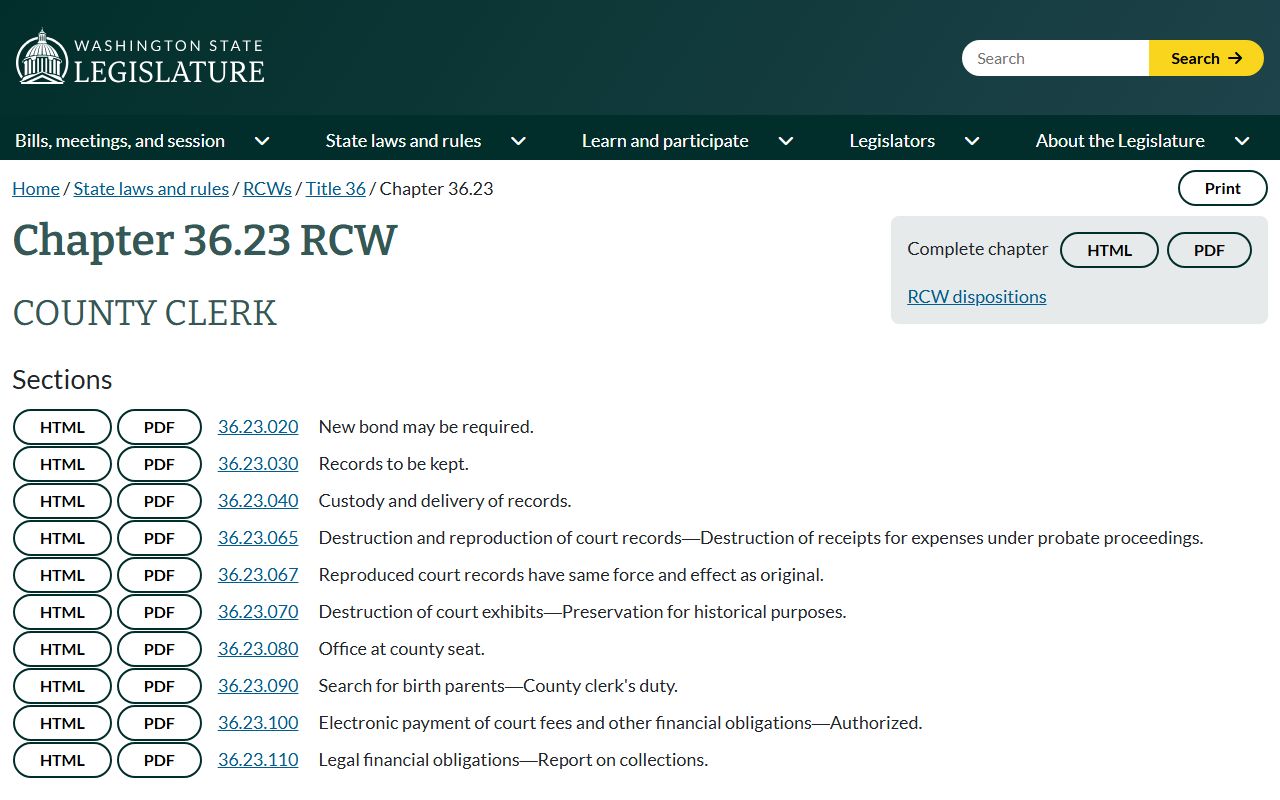
RCW 36.23 at the Washington State Legislature site covers the full scope of county clerk duties in Washington, including the office's role as ex-officio clerk at every court session.
Access to court administrative records follows a different rule. The county says that court records generally are not subject to the Public Records Act, chapter 42.56 RCW, in the same way that county agency records are. Instead, access is governed by court rules and common law. Court administrative records, such as budget documents, staffing records, and policy files maintained by the court administration rather than in a case file, follow GR 31.1. To inspect or copy those records, the request goes to the court administrator with the GR 31.1 form rather than to the Clerk through a standard copy request.
For court records in Superior Court case files, the Clerk is the right starting point. For probate records, the Clerk keeps all Superior Court probate and guardianship files and can provide certified copies of orders, letters testamentary, and other probate documents. For public records held by county agencies other than the courts, requests go through the Kitsap County Public Records Center.
Pro Se and Self-Help Resources
The Kitsap County Clerk links a set of resources for people who represent themselves in Superior Court. The Clerk's pro se handout covers the basics: complete documents in ink or typed, keep at least three copies of every filing, file originals with original signatures, serve the other party through a nonparty adult or process server, and file proof of service afterward. The handout also explains default judgment, how to note a motion or hearing, and what bench copies are and why judges want them.
Self-representation in Superior Court is difficult. The handout says so directly. Court rules and procedures apply whether or not a party has a lawyer. Getting a Courthouse Facilitator can help with family law and Title 11 guardianship procedure, though facilitators do not give legal advice or fill out forms. One practical note: the Clerk has no notary on site. For the oath required to open a probate, you must have the document notarized before you arrive.
The Clerk's forms and kits page at kitsap.gov lists local packets and prices for family law, probate, guardianship, adoption, firearms rights restoration, and other common matters. All kit sales are final with no refunds, resale is not allowed, and mailed kits may take 7-10 business days. Download links expire two days after being sent, so download promptly.
Additional help is available through these organizations the Clerk links:
- Washington Courts statewide forms and instructions
- Kitsap Legal Services, a local legal aid organization.
- Northwest Justice Project CLEAR line for civil legal help.
- WashingtonLawHelp for plain-language legal resources.
- Dispute Resolution Center for mediation as an alternative to court.
For criminal cases where the person cannot afford a lawyer and qualifies as indigent, the Office of Public Defense at Room 103 on the courthouse campus handles felonies, misdemeanors, juvenile matters, dependencies, and civil contempt.